
Catch drainage problems before they get expensive
Signs Your Yard Has Drainage Problems in San Antonio
Soft spots, standing water, and washed-out beds are early warnings. This guide walks you through the most common drainage red flags we see across San Antonio yards so you know when it’s time to bring in a professional.
Request Your Free EstimateLook at how long water hangs around
How do I know if my yard has a real drainage problem?
Most San Antonio yards will stay damp for a short time after a storm—that’s normal. A true drainage problem is when water has nowhere to go and repeatedly saturates the same areas, damages your lawn or beds, or pushes moisture toward your foundation, patios, and retaining walls.If you see standing water 24–48 hours after rain, soggy strips along fences, mulch washing out of beds, or water resting against your home or hardscapes, it’s worth a closer look. The longer these patterns go unchecked, the more they can impact your lawn health, concrete, and structures.
- Normal wet soil after a storm should start to firm up within a day in most areas
- Standing water that lingers more than 24–48 hours is a warning sign
- Repeat puddles in the same locations usually mean slope or drainage issues
- Water that moves toward the house, patio, or retaining wall is higher priority to fix
- Early drainage corrections are far cheaper than repairing foundations and failed landscapes
Read the yard like a site plan
Common Drainage Warning Signs We See in San Antonio Yards
Drainage issues show up in patterns long before serious damage happens. When we walk a property, we look at where water starts, where it slows down, and where it gets stuck. Here are the signs we pay attention to on almost every drainage evaluation. For help turning the advice into a real project, review our drainage solutions service page.
1. Standing water and “bird baths” in the lawn
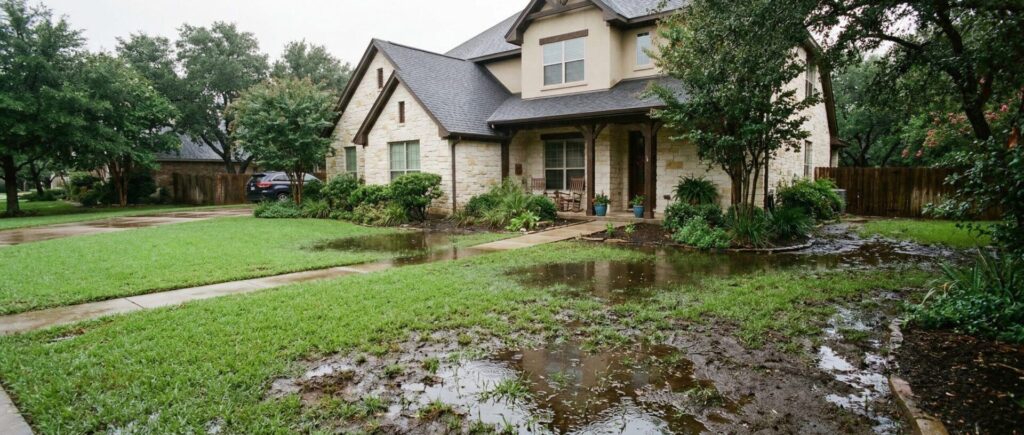
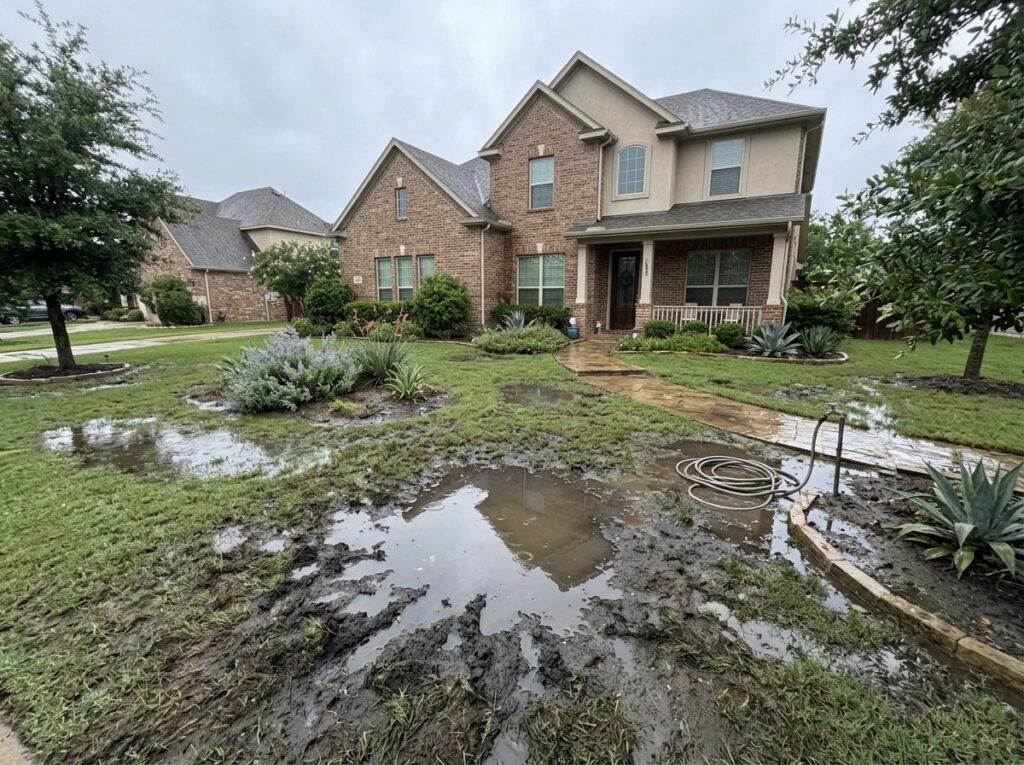
If water is still sitting in the same low spots long after a storm passes, that’s a sign the yard isn’t shedding water properly. In San Antonio clay soils, a little surface water can be normal, but puddles that linger for more than a day or two deserve attention.
- What it looks like: Shallow ponds in the middle of the yard, near gates, between houses, or at the low side of a patio.
- Why it matters: Grass roots suffocate, soil compacts, and mosquito activity increases.
- Typical fixes: Fine-tuning Yard grading / resloping, adding one or more Surface drains & catch basins, and adjusting nearby Downspout drainage.
These jobs are often smaller projects, but ignoring them can slowly kill your lawn and make future Sod Installation more expensive.
2. Soggy strips along fences, walls, and between homes
Long, narrow areas that stay soft even when the rest of the yard has dried out usually tell us water is moving through the soil, not just sitting on top. We see this a lot along fence lines, property lines, and the side yards between two houses.
- What it looks like: Shoes sinking, mower tires leaving ruts, or muddy pet paths along fences.
- Why it matters: Persistent saturation can weaken fence posts, stress roots, and creep toward foundations.
- Typical fixes: Targeted French drains combined with subtle Yard grading / resloping and tie-ins to existing Drainage Installation so the water has a clean exit path.
These areas are easy to overlook until they turn into trench-like mud strips that never quite dry out.
For drainage material planning, compare downspout pop-up with the water issue described above.
For drainage material planning, compare heavy-duty French drain with the water issue described above.
3. Mulch, rock, and soil washing out of beds
When every hard rain rearranges your landscape beds, it’s a sign that too much water is being dumped into the area and the grade isn’t directing flow where it should go.
- What it looks like: Bare soil after storms, mulch piled at the bottom of beds, or rock pushed into the lawn or walkways.
- Why it matters: Exposed soil erodes, plants struggle, and water often ends up running straight toward the foundation or sidewalks.
- Typical fixes: Redirecting Downspout drainage, reshaping beds with better transitions, and installing edging or low walls tied into proper Drainage Installation. Often we follow with updated Landscape Bed Installation so beds hold up better long term.
If the same bed washes out over and over, you don’t have a mulch problem—you have a flow problem.
For a related next step, read Does Yard Grading Fix Drainage?.
For a related next step, read How Downspout Drainage Protects Your Foundation.
For a related next step, read Why Standing Water Is Dangerous for Lawns & Foundations.
4. Warning signs around hardscapes and retaining walls
Concrete and masonry don’t like standing water. When we see stains, algae, or soft spots where patios meet the lawn, or standing water at the base of a retaining wall, that moves a project higher on the priority list.
- What it looks like: Green growth on shaded concrete, water sitting on the low side of a patio, or damp soil at the toe of a wall.
- Why it matters: Water that sits against concrete and walls speeds up cracking, settlement, and structural issues, especially when paired with expansive clay soils.
- Typical fixes: Strategic Surface drains & catch basins, better Yard grading / resloping, and upgraded Retaining Wall Installation drainage when needed.
Addressing these areas early is far less costly than rebuilding failed hardscapes later.
Here goes your text ... Select any part of your text to access the formatting toolbar.
Common Drainage Signs and What They Usually Mean
| Sign You Notice | What It Usually Means | Risk Level | Typical Next Step | Common Fixes We Consider |
|---|---|---|---|---|
| Puddles that last 24–48 hours after rain | Poor surface drainage or low spots holding water | Moderate | Document locations and depth after a storm | Surface drains & catch basins, minor yard grading / resloping, downspout drainage adjustments |
| Soggy strips along fences or between homes | Subsurface water moving through soil | Moderate to High | Probe soil, check slope and neighboring grades | Targeted French drains, yard grading, tie-ins to existing drainage |
| Mulch washing out of beds by the house | Concentrated roof runoff near the foundation | High (foundation and erosion risk) | Watch gutters during a hard rain | Downspout drainage, splash control, re-shaping beds and borders |
| Water stains or dampness near patios and steps | Water sitting against hardscape edges with nowhere to go | Moderate to High | Inspect joints and low spots after storms | Surface drains at hardscape edges, small re-grades, joint sealing |
| Standing water at the base of retaining walls | Insufficient drainage behind or in front of the wall | High | Check weep holes, look for bowing or cracking | Retaining wall drainage upgrades, French drains, improved discharge paths |
| Frequent mosquitoes and soft turf in shaded areas | Chronic moisture and poor evaporation | Moderate | Note shade patterns and wettest spots | Selective grading, surface drains, plant and soil changes, irrigation adjustment |
Prioritize fixes by risk, not just by price
Here goes your text ... Select any part of your text to access the formatting toolbar.
Which Drainage Warning Signs Usually Require Investment First?
Not every drainage symptom carries the same urgency. Puddles in the back corner of the yard may be a comfort issue, while water pressing against your foundation or retaining wall is a higher priority. We help you rank what we find so you can phase work if needed. Before scheduling work, review our drainage expectations so the project expectations are clear.
- Signs near the foundation, patios, and retaining walls usually move to the top of the list because they can impact structures.
- Chronic soggy strips and standing water in primary lawn areas are next, since they affect lawn health and future Sod Installation costs.
- Cosmetic issues, like minor puddles away from the house, can sometimes wait or be bundled into a larger Drainage Installation or Landscape Bed Installation project.
- We often design projects in phases so the most important drainage issues are solved first and future upgrades build on that work.
- Instead of one generic price, your written estimate will outline each drainage zone and the work planned for that area.
Homeowner questions about early warning signs
Drainage Problem Signs FAQs
These answers will help you decide when to keep an eye on a situation and when it’s time to schedule a drainage visit.
See All Frequently Asked Questions- Near your foundation or flowing toward the home
- In high-traffic areas where mud forms or you can’t use the space
- In spots that repeatedly kill grass or stay soggy for days
- Creating mosquito-friendly standing water
- Grading issues (the yard isn’t sloped to move water away)
- Soil that doesn’t absorb well (common in heavy clay)
- Compaction (water can’t soak in)
- Drainage gaps (no clear path for water to exit)
In most yards, visible standing water should start to disappear within about 24 hours.
It’s normal for low spots to stay damp for a short time, especially after a heavier rain.
But if you still see obvious puddles 24–48 hours after a typical storm (and it happens in the same spots over and over), that’s usually a sign the area is holding more water than it should.
It’s more urgent to address if the puddles are:
What this usually points to:
If you’re unsure, a good next step is to take 2–3 photos of the puddles right after the rain and again 24 hours later .
If the water is still pooled, we can help you look at grading and drainage options that fit your yard.
Related: Why Standing Water Is Dangerous for Lawns & Foundations, Faqs/#How Long Should Water Sit In My Yard After It Rains
Not always. Many drainage solutions are focused on specific zones—along fences, near patios, or around downspouts. We plan routes to limit disruption and then restore the work areas with services like Sod Installation, Landscape Bed Installation, and Seasonal Yard Cleanups so the finished yard looks intentional, not patched.
Related: How to Prepare Your Yard for Sod Installation, Landscape Bed Installation Cost Guide, Landscape Bed Installation
Changing a neighbor’s grades is rarely an option, but we can often reshape your side, add Surface drains & catch basins, or use French drains and swales to intercept and redirect water before it causes damage. The goal is to work with what you can control on your property while still respecting drainage laws and boundaries.
Related: Why Standing Water Is Dangerous for Lawns & Foundations, French Drain vs Surface Drain: What’s the Difference?, Faqs/#What If My Neighbor S Yard Is Higher And Pushes Water Toward
Mosquitoes are attracted to standing water, so if you have areas where water repeatedly collects in ruts, plant saucers, or low spots, that can make things worse. Part of a good Drainage Installation plan is eliminating the chronic wet pockets that become mosquito habitat, especially in shaded corners of the yard.
Related: Why Standing Water Is Dangerous for Lawns & Foundations, Drainage Installation, Yard Drainage Cost Guide
Some small issues can be improved by extending downspouts, filling low spots, or cleaning up clogged grates.
However, if water is affecting your foundation, retaining walls, or large areas of turf, it’s better to have a qualified drainage contractor design a complete solution so one change doesn’t cause a new problem somewhere else.
Related: Best Artificial Turf for Dogs, How Long Do Retaining Walls Last?, How Downspout Drainage Protects Your Foundation
One isolated puddle after a very heavy storm isn’t always a concern.
What we watch for is repeat patterns—puddles in the same places after average rains, soft ground you can’t mow, or water that consistently moves toward the house, patios, or fences. When those patterns show up, it’s worth a professional look.
Related: Contact Us, Is Artificial Turf Worth It?, Is Landscape Lighting Worth It?
Turn red flags into a clear plan
Seeing These Drainage Signs in Your Yard?
We’ll walk the property with you, map out problem areas, and design a practical drainage plan that protects your lawn, beds, and structures.