
Value analysis
Is Artificial Turf Worth It in San Antonio?
In South Texas heat and water restrictions, artificial turf can be worth the investment—but only for the right homeowner profile and yard conditions.
Request Your Free EstimateShort answer
When is artificial turf worth it?
Artificial turf is typically worth it in San Antonio when homeowners want reduced maintenance, lower irrigation usage, and consistent appearance year-round.It may not be worth it for homeowners who prefer natural grass cooling or want the lowest upfront cost possible.
- Worth it for low-maintenance lifestyles.
- Worth it in high-water-cost areas.
- Good for heavy pet use.
- Less ideal for those prioritizing natural cooling.
- Higher upfront investment required.
Decision framework
Who benefits most from artificial turf in San Antonio?
Artificial turf isn’t automatically the right choice. In Texas, it makes sense under specific conditions tied to water cost, maintenance tolerance, and yard use. For help turning the advice into a real project, review our artificial turf installation service page.
Best candidates for artificial turf
- Homeowners tired of mowing and fertilizing.
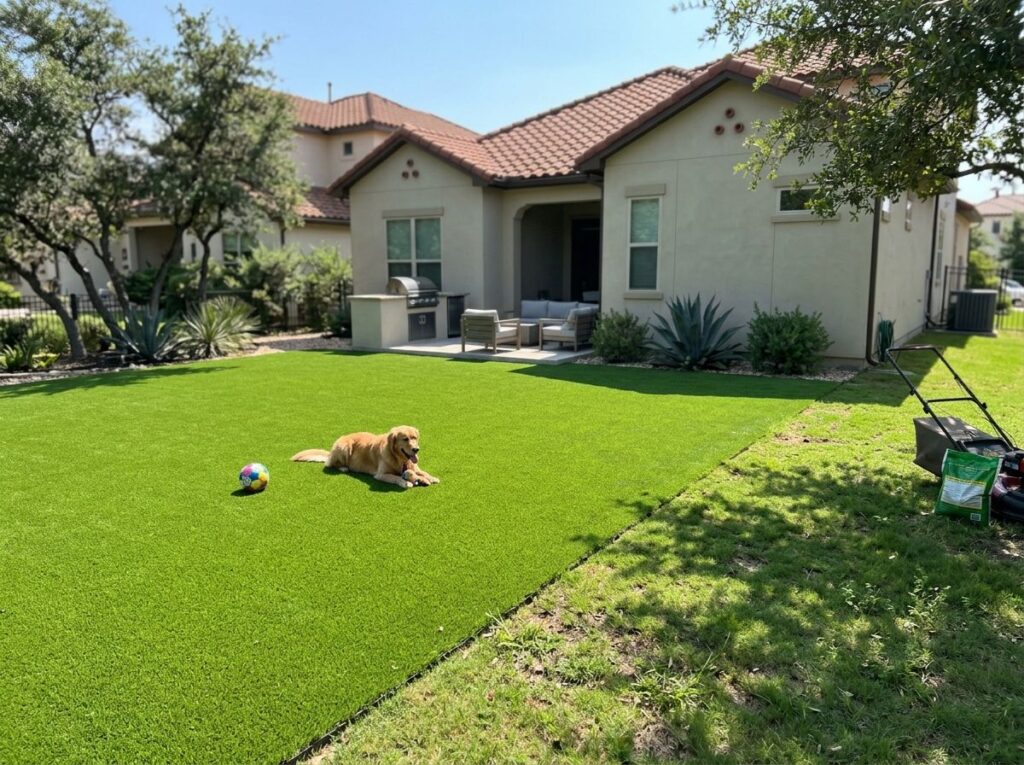
- Yards with heavy pet activity.
- Homes under irrigation restrictions.
- Properties with poor natural grass performance.
When turf may not be ideal
- Homeowners who enjoy lawn care.
- Large open fields where cost scales significantly.
- Shaded yards where natural grass performs well.
For turf selection, compare Elite Lawn Pro Turf with the use case described above.
For turf selection, compare BudgetSaver Green turf with the use case described above.
For turf selection, compare Putting Pro Surface with the use case described above.
Water cost and ROI in Texas
Water bills during peak summer months can significantly affect long-term lawn cost. Turf eliminates irrigation for lawn maintenance.
For a related next step, read Artificial Turf Cost Guide.
For a related next step, read Artificial Turf vs Sod.
For a related next step, read Best Artificial Turf for Dogs.
Resale and curb appeal
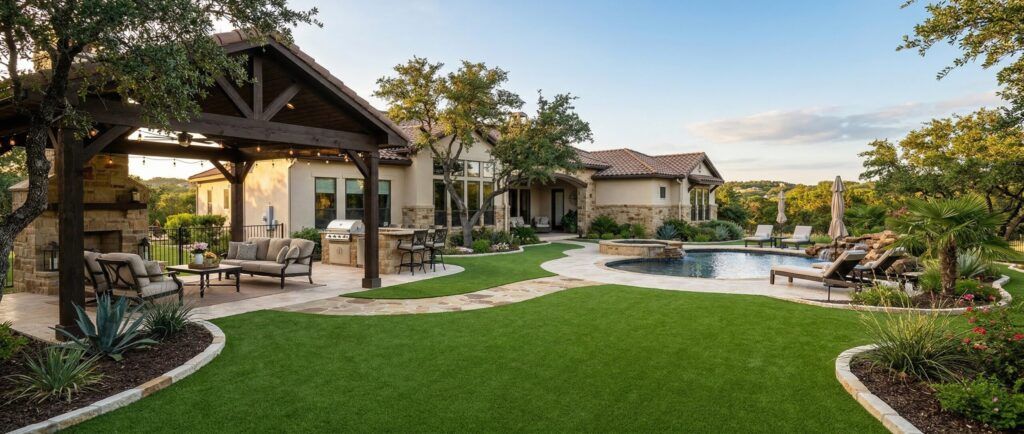
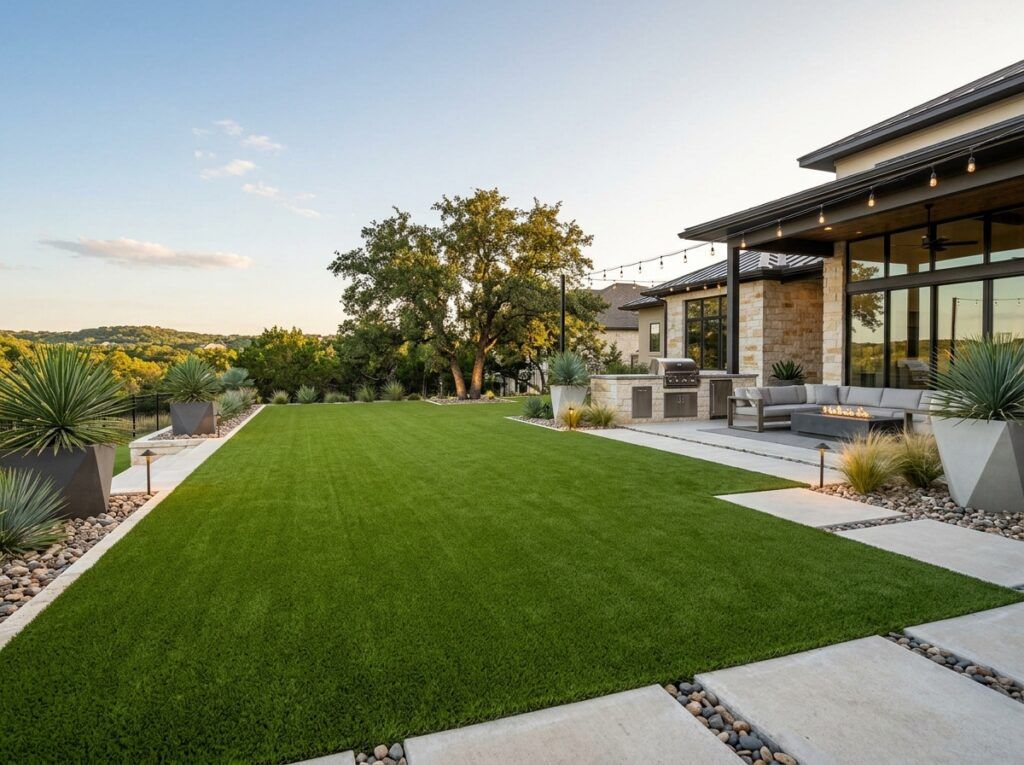
Premium turf installations can enhance curb appeal, particularly in upscale neighborhoods like Stone Oak, Alamo Heights, and The Dominion.
Balanced perspective
Pros and cons of artificial turf in Texas
PROS
- No mowing or fertilizing.
- Reduces irrigation costs.
- Consistent green appearance.
- Durable for pets and play.
CONS
- Higher upfront cost.
- Can get hot in direct sun.
- Does not provide natural cooling.
- Requires proper installation for longevity.
Investment perspective
Here goes your text ... Select any part of your text to access the formatting toolbar.
Cost vs long-term value
Artificial turf typically ranges from $9–$15+ per square foot installed in San Antonio. While the upfront investment is higher than sod, long-term maintenance savings can offset the difference over time.
- Premium turf has higher initial cost but longer lifespan.
- Water savings vary based on irrigation habits.
- Heavy excavation or drainage upgrades increase total cost.
- Resale appeal depends on neighborhood standards.
Worth it FAQs
Artificial turf value questions
Common homeowner questions about value.
See All Frequently Asked Questions- Upfront installation cost: Artificial turf usually costs more to install per square foot than sod because of base preparation, drainage, and the turf product itself. Sod installation includes soil prep and the sod product but is generally lower initial cost.
- Water use: Sod needs regular irrigation, especially in dry climates or during summer. Turf needs none for growth (occasional rinsing or cleaning only).
- Maintenance labor and equipment: Natural grass requires mowing, edging, fertilizing, aeration, overseeding, weed and pest control, and periodic soil amendments. Turf needs minimal maintenance — occasional brushing, debris removal, sanitizing, and infill top-ups over many years.
- Materials and consumables: Fertilizers, seed, herbicides, pesticides, and replacement parts for irrigation systems add recurring costs for sod. Turf’s recurring costs include infill material refresh, seam repairs, and disinfectants for pet/child areas.
- Water and utility costs: In areas with high water costs or water restrictions, the savings from turf can be substantial.
- Replacement lifecycle: Quality turf lasts roughly 8–20+ years depending on use and product; it will eventually need replacement. Sod needs continuous care but doesn’t require full replacement unless damaged or changed.
- Resale and aesthetic value: Some buyers prefer natural lawns; others like low-maintenance turf. Local market preferences can affect property value.
- Environmental and regulatory factors: Consider local water restrictions, incentives (rebates for turf installation in some regions), heat-island effect from turf, and your priorities for biodiversity, carbon sequestration, or pollinator habitat.
- High water-cost or drought-prone regions: Turf is often cheaper over 10+ years because irrigation costs for sod become large.
- Low water-cost, cool/wet climates: Natural sod may be less expensive yearly because irrigation and intensive maintenance are lower; turf’s higher initial cost may not be recovered quickly.
- High-traffic areas (play areas, pet runs, sports): Turf can be more durable and lower-maintenance overall; it may be the better long-term value despite replacement after its lifecycle.
- Large properties versus small lawns: Savings scale with area. On very large areas, turf’s upfront cost rises but so do maintenance and irrigation savings — break-even periods depend on local costs.
- Short-term ownership (under ~5–7 years): Sod is often cheaper if you plan to sell soon because the higher turf installation cost may not be recouped in that timeframe.
- Estimate upfront installation costs for both options (product, site prep, drainage, delivery, labor).
- Estimate annual recurring costs for sod: water (gallons × local rate), mowing (labor or mower costs), fertilizers/pesticides, overseeding, irrigation repairs.
- Estimate annual recurring costs for turf: periodic cleaning, infill top-ups, seam/patch repairs, disinfectants (if pets), and eventual replacement cost amortized over expected life.
- Choose an analysis period (commonly 10 or 20 years). Compute total lifecycle cost for both options: upfront + sum of annual costs (adjust for inflation or discounting if you want present value).
- Factor in non-monetary values: environmental preferences, property resale expectations, and use patterns (kids, pets, sports).
- Upfront: Turf = $15/ft², Sod = $6/ft²
- Annual: Turf maintenance = $0.20/ft²; Sod maintenance (water+care) = $1.20/ft² (varies widely)
- Over 15 years, turf may become cheaper once the cumulative higher upfront cost is offset by lower annual expenses. Exact break-even depends on your local prices.
- What are local water costs and restrictions?
- How many years do you plan to keep the property?
- How will the lawn be used (heavy play, pets, ornamental)?
- Do you have local incentives, rebates, or regulations affecting either option?
- What is the expected life and warranty of the turf product offered?
Yes. Turf can be removed and replaced if desired.
If you share a few details about your yard, we can give you a clearer recommendation.
Related: Best Artificial Turf for Dogs, Artificial Turf Installation, Artificial Turf Care Policy
Some neighborhoods require approval. Check HOA guidelines.
If you share a few details about your yard, we can give you a clearer recommendation.
Related: Best Artificial Turf for Dogs, Project Guidelines Policy, How Long Does Artificial Turf Last?
It reduces water usage but is a synthetic product. Environmental impact depends on perspective.
Related: Best Artificial Turf for Dogs, Why Standing Water Is Dangerous for Lawns & Foundations, Artificial Turf Installation
It depends on water and maintenance costs. Some homeowners see ROI over several years.
Related: Best Artificial Turf for Dogs, How Long Does Artificial Turf Last?, Low-Maintenance Landscape Bed Ideas
In many cases, yes—especially in drought-prone markets—but value depends on buyer preference.
If you share a few details about your yard, we can give you a clearer recommendation.
Related: Best Artificial Turf for Dogs, Home, How Long Does Artificial Turf Last?
Below is a single, expanded FAQ that merges and improves the two original items. It explains cost factors, shows time horizons, and lists scenarios where artificial turf or sod is likely to be cheaper long term.
Is turf (artificial grass) cheaper than sod (natural grass) over the long term?
Short answer: Sometimes.
Artificial turf typically has a higher upfront cost but lower ongoing costs (water, mowing, fertilizing, pest control). Over a typical ownership horizon (often 10–20 years), turf can be less expensive — but it depends on site-specific factors and how you value non-monetary benefits.
How to compare costs — the main factors
Typical cost comparison scenarios
How to calculate which is cheaper for you
Example (illustrative numbers)
Questions to answer before deciding
Bottom line
Artificial turf can be cheaper than sod over the long term, especially in dry or high-water-cost areas and for high-use lawns.
However, in cooler, wetter regions or for short-term ownership, sod may be the lower-cost choice. The best approach is a simple lifecycle cost comparison using your local installation quotes, water rates, and maintenance costs combined with your personal priorities.
If you’d like, provide your zip/postal code, lawn area (square feet), and a few details (climate, water cost, expected years you’ll keep the property, and how the space will be used) and I’ll run a tailored cost comparison and break-even estimate.
Related: Project Guidelines Policy, Best Artificial Turf for Dogs, How to Prepare Your Yard for Sod Installation
Make the right choice
Get a professional evaluation before deciding
We’ll assess sun exposure, water use, traffic, and budget to determine whether artificial turf is the right investment for your San Antonio yard.