
Purpose and where warranty terms live
This page covers basic artificial turf care, maintenance expectations, and common issues to watch for.
Warranty terms (workmanship vs. manufacturer) and the claim process are available on our Service Warranty page. Manufacturer coverage can vary by turf type.
Definitions and notice timing rules used across policies are available at policies. We do not restate them here.
Basic routine care
Artificial turf stays in better shape with basic upkeep. The goal is simple: remove debris, rinse when needed, and address spills quickly.
Debris removal
- Remove leaves and debris so they do not break down into the turf.
- Use common tools like a leaf blower, broom, or rake (use normal care to avoid damaging edges).
Rinsing and washing
- Rinse dust and pollen as needed.
- If you have pets, rinse pet areas as needed.
- Keep drains/edges clear so water can move off the turf surface (this does not guarantee performance in extreme storms).
Spot cleaning
- For most spills, use mild soap and water.
- Avoid harsh chemicals or solvents unless you have product-specific guidance from the manufacturer.
Brushing and fiber matting
In higher-traffic areas, turf fibers can look matted over time.
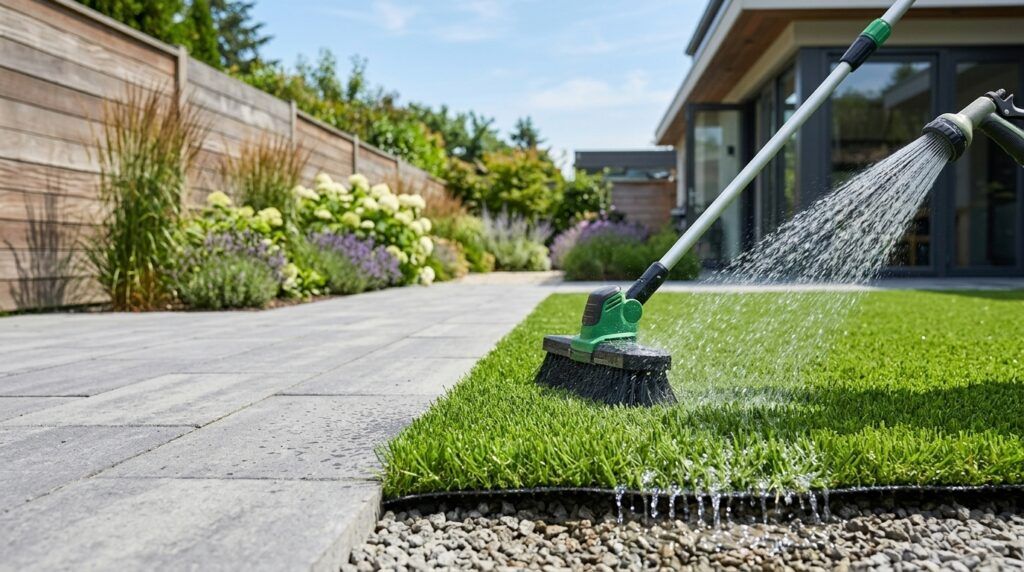
- If fibers appear matted, brush the area to help lift them.
- Use normal care and avoid aggressive tools that could damage the turf or edges.
Pet use and odor management
- Remove solid waste promptly.
- Rinse urine areas as needed.
- If odor persists, you can use an approved odor-neutral product (do not use harsh chemicals).
Persistent odor usually relates to maintenance and environmental conditions and is not a workmanship defect.
Heat and surface temperature
Artificial turf can get hot in direct sun, similar to concrete or asphalt.
- Use common-sense steps during peak heat: shade, footwear, limited play time, and light rinsing for temporary cooling.
Seams, edges, and settling
Some changes over time can be normal. Know what to watch for:
- May be normal: minor infill displacement and minor settling.
- Not normal: lifting edges, visible seam separation, or significant movement.
If you notice lifting edges, visible seam separation, low spots, or significant movement, document it with photos and report it. See our Service Warranty Overview page for claim steps.
What can void coverage / not be covered
Examples of issues that can void coverage or are not covered include:
- Misuse (abuse, sharp objects, dragging heavy items)
- Acts of nature / extreme weather events
- Conditions outside your control (standing water due to property drainage, soil movement, flooding)
- Third-party modifications or repairs after installation
- Chemical damage (harsh chemicals/solvents)
- Lack of basic maintenance leading to preventable issues
- Pet damage beyond normal use/neglect
For risk boundaries and site conditions, see the Damage, Risk & Liability Policy.
How to report an issue
If you have a concern, report it as soon as possible with photos.
- Take a wide photo and a close-up photo.
- Note the area and what you are seeing (lifting edge, seam showing, low spot, drainage issue, odor area).
- Send by text or email.
Notice timing rules: Policies. Written notices sent outside business hours are treated as received at 8:00 AM CT on the next business day. Please confirm receipt.
Claim steps and warranty terms: Warranties
Related policies and claim steps
- Warranties Policy (workmanship vs manufacturer; claim process)
- Damage, Risk & Liability Policy (acts of nature, site conditions, drainage realities)
- Change Orders & Scope Policy (if additional drainage or corrections are needed beyond scope)
- /policies/ (definitions + notice timing)
Reminder: Known warranty facts for artificial turf include a 2-Year Limited Workmanship Warranty and a 15-Year Manufacturer’s Turf Warranty (coverage may vary by turf type). Optional Premium Warranty Plans exist, but details vary: TODO[CONFIRM: Provide Premium Plan details if you want them listed here.]