
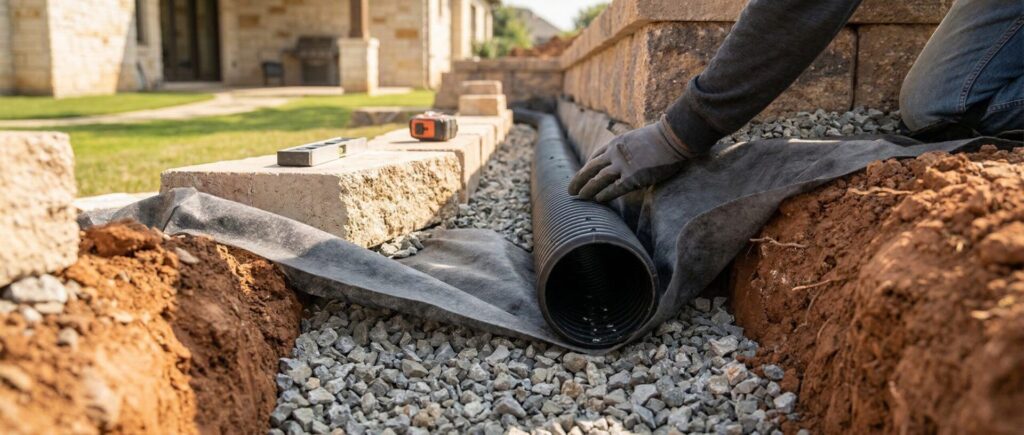
Most retaining wall problems start with water, not the blocks
Retaining Wall Drainage: Why It Matters in San Antonio
A retaining wall that looks great on day one can still fail early if water has nowhere to go. In San Antonio’s clay and rocky soils, proper drainage behind and around the wall is what keeps it stable, straight, and safe over time.
Request Your Free EstimateDrainage is the hidden structure that protects your wall
What Retaining Wall Drainage Does—and What Happens Without It
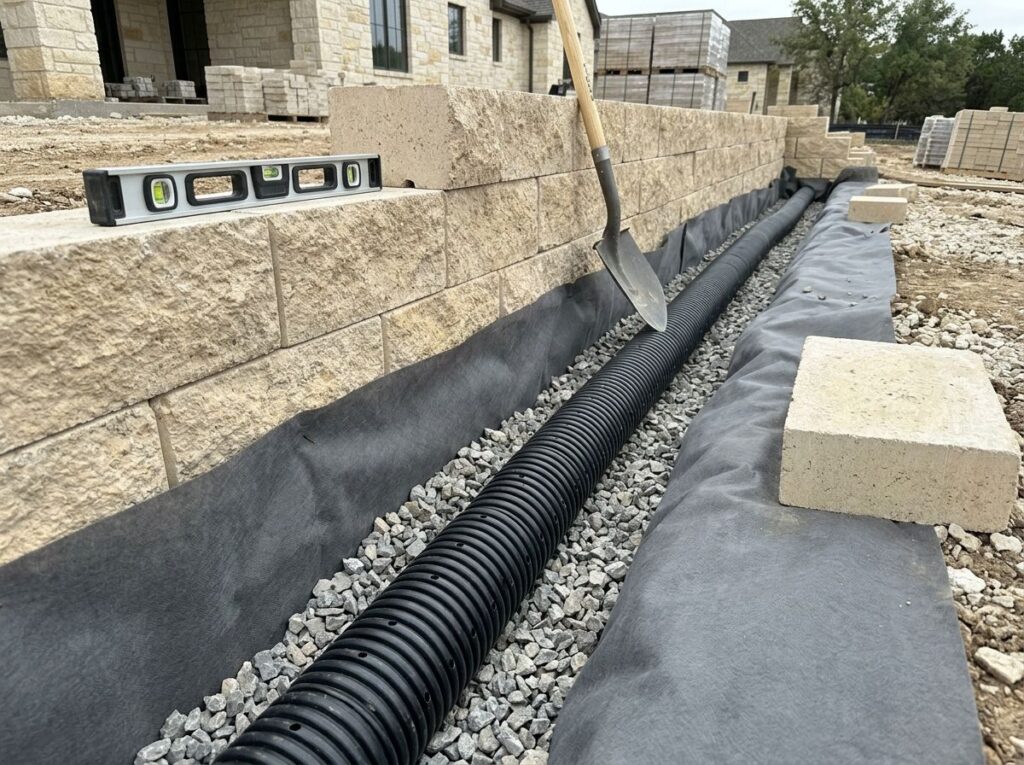
Behind every long-lasting retaining wall is a simple idea: water needs a controlled path out. In our area, that usually means clean gravel, filter fabric, and a drain pipe that lets water move away from the wall instead of pushing on it.When drainage is missing or undersized, water builds up in the soil behind the wall. That extra pressure shows up as bowing, leaning, cracking, or blowouts, especially after heavy Texas storms. It can also stain the face of the wall and soften the soils that the wall is relying on.Good drainage design doesn’t have to be complicated, but it does need to be intentional and matched to your yard’s slopes, soil, and how much roof or surface water is headed toward the wall.
- Drainage controls how water moves through and away from the soil behind your wall
- Without drainage, water builds pressure and can push even heavy walls out of alignment
- Gravel backfill, filter fabric, and perforated drain pipe are standard tools for protecting a wall
- Tying in French drains, surface drains, and downspout drainage often improves both wall life and overall yard drainage
Design the water path before you stack the first block
How Retaining Wall Drainage Works in a Real San Antonio Yard
Instead of viewing the wall as a stand-alone feature, it helps to think of it as part of a small drainage system. The wall, backfill, pipe, and surrounding yard all need to work together so water doesn’t get trapped where it can do the most damage.
1. What “drainage” really means behind a retaining wall
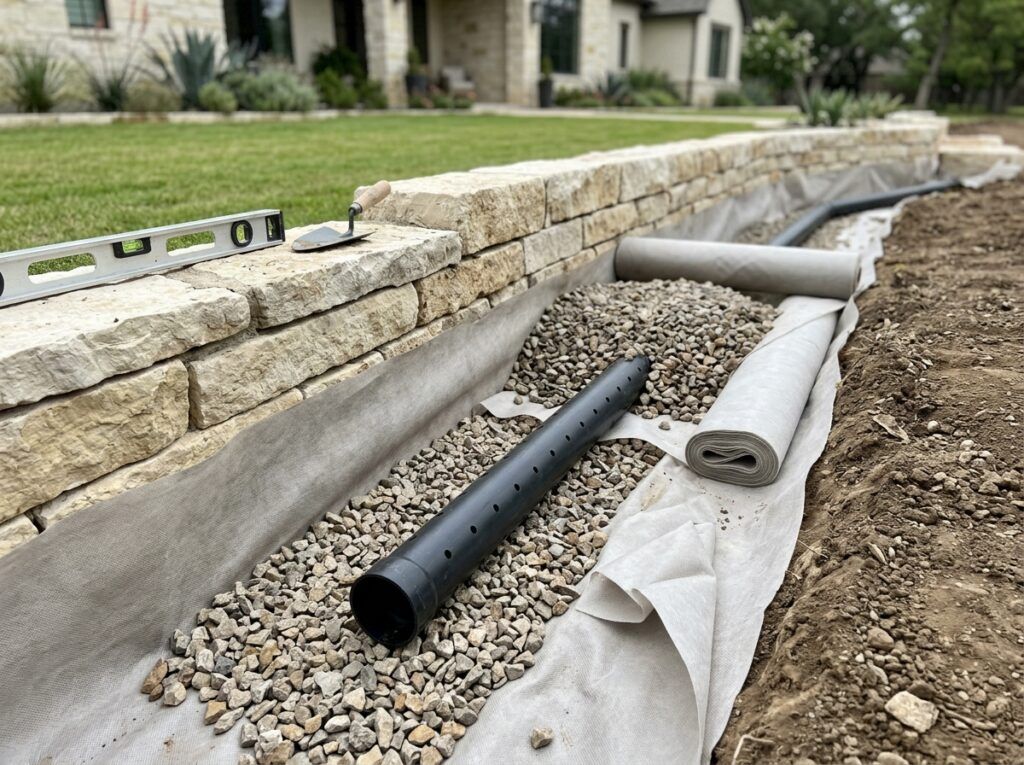
Retaining wall drainage is more than just dropping a pipe in a trench. A well-detailed wall in San Antonio usually includes:
- Clean gravel backfill: A column of stone behind the wall so water can move freely instead of sitting in clay.
- Perforated drain pipe: Laid at or near the base of the wall to collect water and direct it to an outlet.
- Filter fabric: To keep soil from clogging the gravel and pipe over time.
- Graded outlets: The pipe needs somewhere to daylight or tie into another Drainage Installation component.
All of this is hidden once the wall is finished, but it is doing the quiet, everyday work that helps the wall last.
2. How San Antonio soils and slopes affect wall drainage
Our local soils are often a mix of heavy clays and rock. Clay tends to hold water instead of letting it pass through. On a slope, this can mean water traveling along the back of the wall and building pressure instead of draining straight down.
- On steep lots, water wants to move quickly downslope and collect at the base of the wall.
- Clay soils expand and contract with moisture, increasing movement if water is not managed.
- Thin topsoil over rock can cause water to run along hard layers and press directly against the wall.
That is why drainage design is so important when we pair Retaining Wall Installation with yard grading / resloping on San Antonio properties. The layout needs to respect how water already wants to move through the site.
For wall material planning, compare geogrid reinforcement with the slope and soil conditions discussed above.
For wall material planning, compare structural retaining wall blocks with the slope and soil conditions discussed above.
3. Tying wall drainage into the rest of your yard drainage
Retaining wall drainage works best when it is coordinated with the rest of your yard. In many projects, that includes:
- French drains: To intercept groundwater or surface water upslope before it reaches the wall.
- Surface drains & catch basins: To collect low spots and patio areas and route water to safer discharge points.
- Downspout drainage: To keep roof runoff from dumping directly at the top or base of the wall.
Solving these issues at the same time lets you protect the wall, your lawn, and any nearby Landscape Bed Installation or hardscaping. It also makes it easier to maintain healthy Sod Installation in the areas above and below the wall.
For a related next step, read When Do You Need a Retaining Wall?.
For a related next step, read Retaining Wall Cost Guide.
For a related next step, read Do I Need a Permit for a Retaining Wall?.
4. Warning signs that your wall may have drainage problems
Because the drainage components are buried, you often detect problems by watching the wall and the ground around it:
- Water seeping through the face or joints long after a storm.
- Mud stains or efflorescence (white mineral deposits) on the face of the wall.
- Wet, spongy ground or sinkholes behind the wall.
- Bowing, leaning, or gaps opening between blocks or stones.
If you see these signs, it is worth having the wall and nearby drainage evaluated. In some cases, adding or improving French drains or surface drainage can relieve pressure. In others, the safest solution is to replace the wall with a design that includes appropriate drainage from the start.
Here goes your text ... Select any part of your text to access the formatting toolbar.
Common Retaining Wall Drainage Setups and Their Risks
| Wall Setup | Drainage Approach | Typical Outcome in San Antonio | Risk Level Over Time |
|---|---|---|---|
| Block or stone wall with gravel backfill and drain pipe | Clean gravel, filter fabric, perforated pipe to daylight or sump | Water moves away from the wall, lower pressure, better freeze/thaw performance and less staining | Lower risk when built and maintained correctly |
| Wall with gravel but no clear outlet | Some stone behind wall but no pipe or exit point | Helps some, but water can still collect behind the wall during heavy storms | Moderate risk, especially on taller walls or heavy slopes |
| Wall backfilled with native soil only | No gravel, no pipe, soil holds moisture | Soil stays saturated, pressure builds, more movement, leaning, and staining over time | High risk, common cause of early failure |
| Wall with surface water managed and downspouts tied in | Combination of wall drainage, downspout drainage, and surface drains | Less water reaching the wall, more predictable performance and longer lifespan | Lower risk, best practice for long-term stability |
These are general patterns, not guarantees. Every site needs its own evaluation.
Invest in drainage once to avoid paying for structural fixes later
Pros and Cons of Prioritizing Retaining Wall Drainage
PROS
- Proper drainage design reduces pressure on the wall and supports a longer service life.
- Handling roof runoff and surface water while you build the wall can prevent future erosion and washouts.
- Clear drainage details make it easier to compare bids and understand why one proposal may cost more.
- Thoughtful drainage planning often protects nearby patios, sod, and landscape beds at the same time.
CONS
- Drainage work adds cost and labor up front compared with simply stacking blocks or stone.
- Much of the critical drainage work is buried, so it is not obvious when it is skipped or underbuilt.
- Retrofitting drainage behind an existing wall is often more complicated than including it from day one.
Drainage is a small part of the project that protects the whole wall
Here goes your text ... Select any part of your text to access the formatting toolbar.
How Drainage Affects Retaining Wall Cost in San Antonio
Most of the cost of good wall drainage is buried in excavation, gravel, pipe, and proper layout. While it adds to the up-front price compared with stacking block directly on soil, it is one of the most important factors in how long the wall will realistically last in our climate. Before scheduling work, review our retaining wall expectations so the project expectations are clear.
- Retaining wall drainage is usually priced as part of the wall system, not as a separate line item, but it still represents real excavation, gravel, pipe, and labor costs.
- Expect more complex drainage solutions near structures, steep slopes, or where roof runoff must be redirected away from the wall.
- Adding yard drainage work such as French drains, surface drains, or downspout tie-ins during a wall project may be more cost-effective than tackling those problems later.
- Because soils, slopes, and access vary, the only way to get accurate pricing is a site visit and a written design-driven proposal.
Answer the water questions before you build the wall
Retaining Wall Drainage FAQs
These questions focus on real drainage decisions we see in San Antonio yards, not generic advice.
See All Frequently Asked QuestionsThe best approach is to plan both together.
When we combine Retaining Wall Installation with yard grading, French drains, or surface drains, we can control how water moves on the property and protect the wall, lawn, and outdoor living areas at the same time.
Related: Signs Your Yard Has Drainage Problems, Retaining Wall Installation, When Do You Need a Retaining Wall?
Weep holes are designed to let water escape, but they work best when tied to proper gravel backfill and a clear drainage path.
If the wall was backfilled with soil and only has a few small weep holes, those openings can clog and may not relieve enough pressure during heavy storms.
Related: Signs Your Yard Has Drainage Problems, Retaining Wall Installation, When Do You Need a Retaining Wall?
Downspouts that discharge at the top or base of a wall can overload the drainage system and erode soil.
We typically recommend routing downspout drainage away from the wall with solid pipe so roof runoff does not add constant water to the backfill zone.
Related: Signs Your Yard Has Drainage Problems, Retaining Wall Installation, When Do You Need a Retaining Wall?
Yes, for most structural walls.
Clean gravel creates an easy path for water to move down to the drain pipe and out of the system. Backfilling with native clay soil traps water, increases pressure on the wall, and can shorten its lifespan significantly.
Related: Retaining Wall Installation, When Do You Need a Retaining Wall?, Retaining Wall Expectations Policy
Sometimes.
In some cases we can improve drainage by adding French drains upslope, redirecting downspouts, or installing surface drains to keep water away from the wall. In other cases, the only way to properly add drainage is to excavate behind the wall or rebuild it with the right backfill and pipe from the start.
Related: Signs Your Yard Has Drainage Problems, Retaining Wall Installation, When Do You Need a Retaining Wall?
Most structural retaining walls in our area benefit from a drain pipe because of our clay soils and intense storm events.
Very low garden walls on well-draining slopes may be fine with gravel-only backfill, but as walls get taller or see more water, a perforated pipe to daylight or a sump becomes a best practice.
Related: How Long Do Retaining Walls Last?, Concrete Block vs Limestone Retaining Walls, French Drain vs Surface Drain: What’s the Difference?
Let’s make sure your wall and drainage plan work together
Need a Retaining Wall and Drainage Plan for Your Yard?
We can walk your property, study how water currently moves, and design a retaining wall and drainage solution that supports your long-term plans instead of fighting your slopes and soil.