
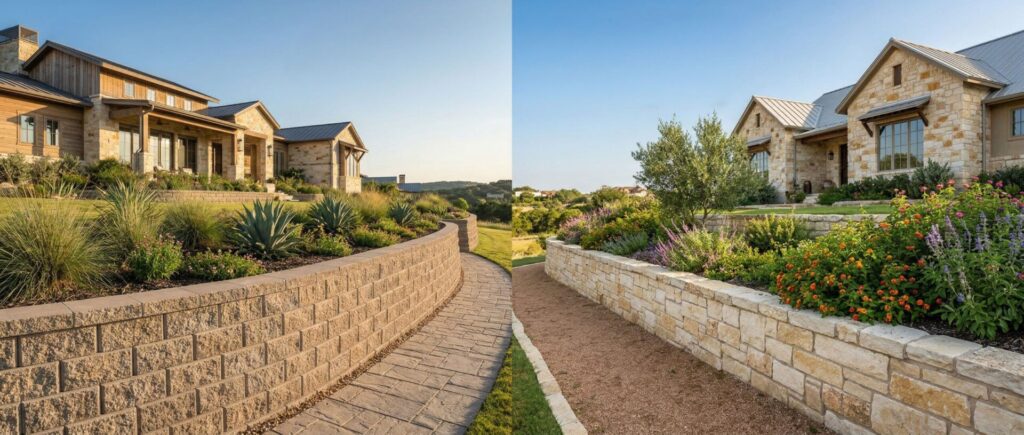
Match the wall system to the work it needs to do
Concrete Block vs Limestone Retaining Walls
Both concrete block and limestone retaining walls can look great in a San Antonio yard, but they behave differently once you start holding back soil. This guide helps you decide which system fits your slope, soil, and budget so you are not choosing based on looks alone.
Request Your Free EstimateStart with what the wall needs to hold, not just how it looks
Which is better in San Antonio—concrete block or limestone?
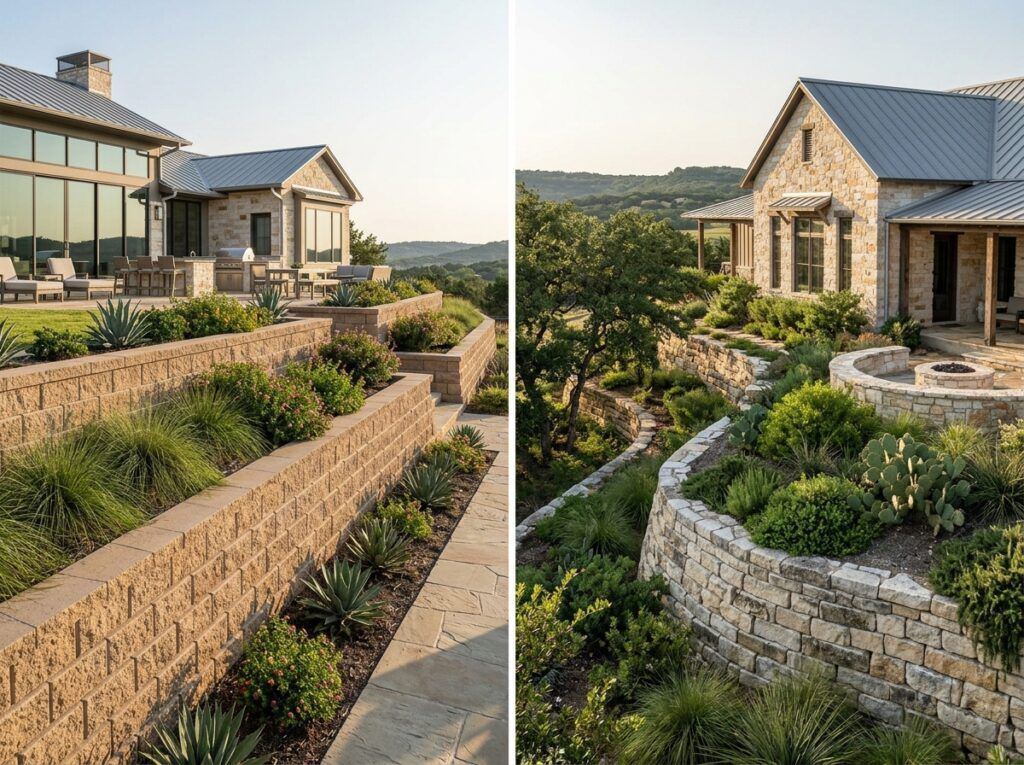
For most structural retaining walls in San Antonio—especially where you are cutting into a slope or holding back several feet of soil—a modern concrete block system is usually the more predictable and cost-efficient choice. These modular blocks are designed to interlock, lean into the hillside, and integrate with geogrid and drainage stone.Limestone and chopped stone walls shine when the wall is more visible than tall: front planters, low seat walls, and accents along drives or entries where a natural Hill Country look is the priority. They can still retain soil, but they demand careful base prep and drainage to stay stable over time.
- Use concrete block systems for most taller or structure-adjacent retaining walls where strength, predictability, and engineered options matter
- Choose limestone or chopped stone for low to medium-height walls, planters, and focal areas where the natural rock look fits your home
- Both wall types require proper base, drainage stone, and perforated pipe to perform in San Antonio’s soils
- Your final decision should balance appearance, wall height, slope, and how the wall ties into grading, drainage installation, and surrounding landscaping
Think in terms of structure first, style second
How to Choose Between Concrete Block and Limestone Walls
Instead of asking which material is universally better, ask which one fits the work your wall needs to do. A short planter along a front walk has different demands than a wall holding back a driveway or leveling a patio. Once you know what the wall is responsible for, it becomes much easier to compare concrete block and limestone fairly.
1. What we mean by “concrete block” retaining walls
When we talk about concrete block for retaining walls, we are usually referring to modular segmental retaining wall blocks—not hollow cinder blocks stacked like building walls. These blocks are:
- Designed to lock together and lean slightly back into the slope
- Installed on a compacted base with drainage stone and fabric behind the wall
- Compatible with geogrid reinforcement when the wall is taller or holding more load
For San Antonio yards with real elevation changes, this system gives us a reliable way to build walls that work with the soil instead of fighting it. It also pairs well with Yard grading / resloping and Drainage Installation so the entire slope drains correctly.
2. Where limestone and chopped stone walls make the most sense
Limestone and chopped stone are a natural fit for Hill Country architecture. They are ideal when:
- The wall is relatively low to medium height and highly visible
- You want planters, seat walls, or accents that match stone on the house or other features
- The main goal is curb appeal along drives, walks, and Landscape Bed Installation
These walls still need compacted base, drainage stone, and sometimes reinforcement, but the face of the wall reads as natural rock instead of modular units. That makes them a strong choice for front elevations and outdoor living areas where the wall is part of the overall design statement.
For wall material planning, compare garden wall blocks with the slope and soil conditions discussed above.
For wall material planning, compare chopped limestone wall stone with the slope and soil conditions discussed above.
For wall material planning, compare retaining wall caps and coping with the slope and soil conditions discussed above.
3. How each material behaves with San Antonio slopes and soils
Our area combines clay, rock, and hardpan, and water does not always move in a predictable way. That is why every retaining wall, regardless of material, should be treated as part of a larger grading and drainage plan.
- Concrete block systems give us clear manufacturer guidance on base depth, geogrid length, and backfill details. When the wall is tall or supports a driveway, that kind of predictability is valuable.
- Limestone and chopped stone have the weight and durability for long service life, but they rely heavily on the installer’s experience with footing prep, drainage, and how courses are tied together.
In both cases, we often tie walls into French drains, surface drains and catch basins, and downspout drainage so water has a clear path away from the wall and nearby structures.
For a related next step, read How Long Do Retaining Walls Last?.
For a related next step, read Retaining Wall Drainage: Why It Matters.
For a related next step, read When Do You Need a Retaining Wall?.
4. A simple decision framework for your yard
When we walk a property, we usually start with a few simple questions:
- Is this wall mostly decorative, mostly structural, or both?
- How tall does it need to be at its highest point to create the space you want?
- Is it near a slab, driveway, pool, or property line where movement would create problems?
- Do you want it to blend quietly into the landscape, or be a visible feature?
If the wall is tall, near structures, or clearly doing the heavy lifting for the slope, we often lean toward a concrete block system. If the wall is shorter, in a front-facing area, and meant to tie into stone on the home or landscape beds, natural stone may be the better fit. From there, we can design the base, drainage, and backfill so whichever material you choose has the support it needs.
Here goes your text ... Select any part of your text to access the formatting toolbar.
Concrete Block vs Limestone Retaining Walls at a Glance
| Factor | Concrete Block Retaining Wall | Limestone / Chopped Stone Retaining Wall |
|---|---|---|
| Typical Use | Structural walls, taller slopes, walls that may need engineering or geogrid reinforcement | Low to medium-height walls, planters, accents, and visible faces where style matters most |
| Look and Style | Clean, modular appearance; available in different face textures and colors | Natural Hill Country look; each stone has unique color and character |
| Fit for San Antonio Soils | Performs well when paired with proper base, drainage stone, and geogrid where needed | Works well when built on solid footing with drainage, but heavier units can be sensitive to poor base prep |
| Curves and Layout | Blocks are designed to step into curves and consistent radiuses easily | Curves are possible but more hand-fitted; straight runs and gentle bends are most efficient |
| Drainage Integration | Pairs naturally with perforated pipe, gravel backfill, and fabric behind the wall | Requires the same drainage details; more important to avoid trapped water behind solid stone faces |
| Relative Installed Cost | Often more cost-efficient for taller structural walls per square foot of wall face | Usually higher per square foot of face, especially for cut stone or larger heights |
| Maintenance and Lifespan | Low maintenance when built correctly; easy to repair small sections if needed | Very durable when detailed well; individual stones may shift over time if base or drainage were not handled properly |
| Where It Shines | Yards with real elevation change where you need strength, predictability, and a clear design system | Front-facing walls, planters, and visible features on homes that lean into natural stone and Hill Country style |
Both systems can be “right” when matched to the right job
Pros and Cons of Concrete Block and Limestone Retaining Walls
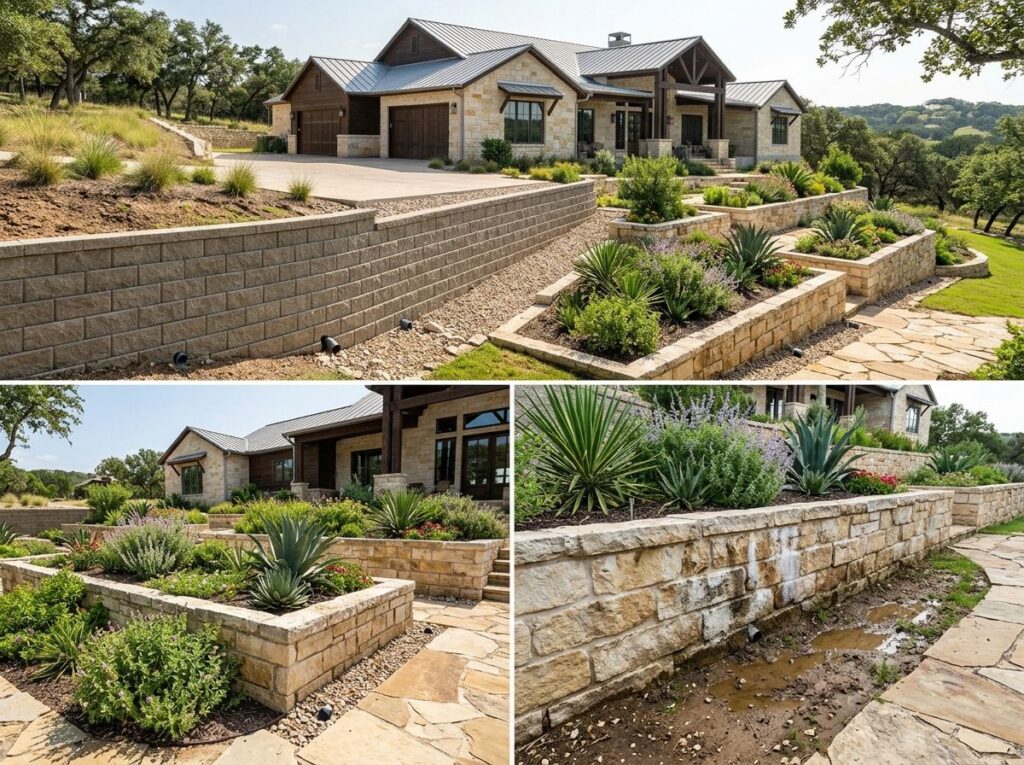
PROS
- You can match the wall type to the job: concrete block for taller structural walls, limestone or chopped stone for visible accents and planters
- Both systems can be detailed with proper drainage, base, and backfill so they perform well in San Antonio’s clay and rock soils
- Concrete block walls offer predictable engineering options for slopes that truly need reinforcement
- Limestone and chopped stone walls align well with Hill Country architecture and natural rock features
- Either wall type can be tied into grading, Drainage Installation, and landscape beds for a finished look
CONS
- Choosing based on looks alone can lead to overpaying for stone where a structural block wall would perform better
- Building tall walls in solid stone without the right footing or drainage can create long-term movement issues
- Concrete block walls that ignore aesthetics can look out of place on highly visible front elevations
- Skipping proper drainage and backfill details undercuts the strengths of both materials, regardless of which you choose
Think in terms of wall face area and complexity
Here goes your text ... Select any part of your text to access the formatting toolbar.
Cost Considerations: Concrete Block vs Limestone in San Antonio
Retaining wall budgets are driven by more than the block or stone you see. Excavation, base prep, drainage, and access can all carry as much or more weight than the face material. That said, concrete block systems often offer better value on taller structural walls, while limestone and chopped stone typically cost more per square foot of wall face but deliver a higher-end, natural look in visible areas. Before scheduling work, review our retaining wall expectations so the project expectations are clear.
- Installed pricing for retaining walls is usually calculated by the square foot of wall face rather than just linear feet.
- Concrete block systems often offer better value on taller walls because they are engineered to stack, batter, and reinforce predictably.
- Limestone and chopped stone walls typically carry a premium per square foot of wall face, especially when you want tightly fitted, visible faces.
- Excavation, access, haul-off, and drainage upgrades can push costs up for either material choice; they are often larger drivers than the block or stone itself.
Answer key questions before you commit to a material
Concrete Block vs Limestone Retaining Wall FAQs
These questions focus on real field decisions—height, slope, budget, and style—so you can choose a wall system that makes sense for your property.
See All Frequently Asked QuestionsStart by clarifying how tall the wall needs to be, what it will be holding back, and how visible it will be from the street and outdoor living areas.
From there, weigh structural needs against the look you want. A site visit is the best way to match material choice to slope, soil, and the rest of your landscape plan.
Related: Retaining Wall Installation, When Do You Need a Retaining Wall?, Retaining Wall Expectations Policy
Concrete block systems are often easier to adjust in small sections because each unit is part of a modular system.
With limestone and chopped stone, repairs may involve more hand-fitting to match patterns and maintain the natural look. In both cases, catching drainage or movement issues early keeps repairs smaller.
Related: Signs Your Yard Has Drainage Problems, Retaining Wall Drainage: Why It Matters, Faqs/#Is One Type Of Wall Easier To Repair If Something Goes Wrong
In some designs, a structural concrete block or modular wall is used to handle the load, and stone is applied in front as a veneer or integrated in adjacent landscape beds.
This approach can balance performance and style, but it requires careful detailing so the veneer and structural wall work together.
Related: Faqs/#Use Concrete Block Behind The Scenes And Stone On The Face
Both can last a long time when built on a proper base with good drainage.
Limestone has a timeless look and is naturally durable, but heavy stones set on poor footing or without drainage can shift. Concrete block walls that follow manufacturer details also have a long service life. In most yards, workmanship and drainage matter more than the face material alone.
Related: Signs Your Yard Has Drainage Problems, How Long Do Retaining Walls Last?, Retaining Wall Drainage: Why It Matters
When a wall is tall or supporting areas where vehicles and hardscape are nearby, a concrete block system is often the first choice because it integrates cleanly with geogrid, drainage stone, and engineering guidance.
The priority in those situations is predictable performance; stone accents can be added in other parts of the landscape.
Related: Signs Your Yard Has Drainage Problems, Retaining Wall Installation, Retaining Wall Drainage: Why It Matters
For taller structural walls, modular concrete block systems are often more cost-efficient per square foot of wall face because they are designed to stack, lean, and reinforce predictably.
Limestone and chopped stone walls usually carry a higher installed cost in exchange for the natural look, especially on front-facing or highly visible areas.
Related: How Long Do Retaining Walls Last?, Faqs/#Which Is Usually More Affordable Concrete Block Or Limestone
Choose the wall system that fits your yard—not someone else’s
Want Help Comparing Retaining Wall Options for Your Property?
We’ll walk your slopes, look at how water moves, and talk through where concrete block makes sense, where limestone shines, and how each option fits your budget and long-term plans.