
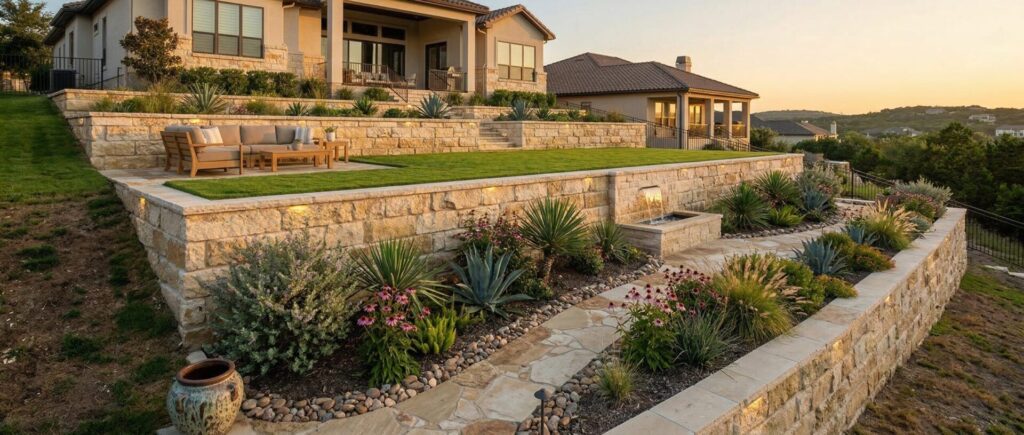
You don’t always need a wall—but when you do, it needs to be done right
When Do You Need a Retaining Wall in San Antonio?
Not every slope needs a retaining wall. In many San Antonio yards, smart grading and drainage are enough. This guide walks you through the real-world situations where a wall is worth the investment—and when simpler solutions may be the better choice.
Request Your Free EstimateStart with the problem, not the product
How to Tell If You Really Need a Retaining Wall
You need a retaining wall when soil is trying to move where it should not go—or when your yard is too steep to use without creating level areas. Common triggers include erosion on slopes, soil pushing on patios or foundations, and drop-offs that are unsafe or hard to maintain.In other cases, a wall is more of a design choice than a structural requirement. Gentle slopes, small height changes, and basic drainage issues can often be handled with grading, French drains, and smart plant selection instead of masonry or block.A good decision starts with what you’re trying to fix: stability, usability, drainage, or aesthetics. From there, you can decide whether to invest in Retaining Wall Installation or focus first on drainage and grading work.
- Walls are most critical where soil movement threatens structures, driveways, or walkways
- Steep slopes that erode or are impossible to use often benefit from a retaining wall and re-grading
- Flat yards with standing water usually need drainage solutions, not a wall
- Start by defining the problem—stability, drainage, or layout—before deciding on a wall
Match the solution to what your yard is actually doing
Real Situations Where a Retaining Wall Makes Sense
Instead of asking “Do I want a wall?”, it’s more helpful to ask “What is my yard doing right now, and what do I want it to do?” Here’s how we look at common San Antonio scenarios before recommending a retaining wall, grading, or a drainage-only approach.
1. When slopes are too steep to use or maintain
Many Hill Country and North San Antonio properties have strong grade changes from the house out toward the fence line. When that slope becomes too steep, you may notice:
- Grass that is hard to mow or keep rooted on the hillside.
- Soil washing down into Landscape Bed Installation areas after storms.
- Kids and pets avoiding the area because it feels unsafe or unusable.
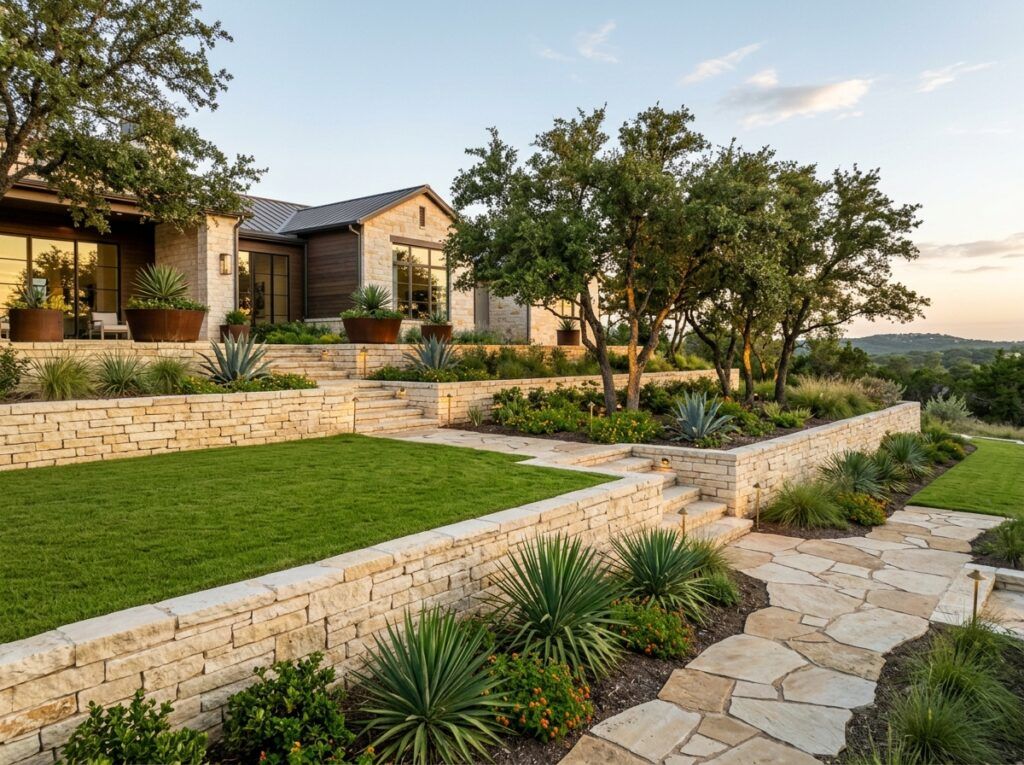
In these cases, a retaining wall combined with yard grading / resloping can flatten part of the yard for sod, play, or outdoor living, while the wall holds back the remaining slope. The goal is not just to “build a wall,” but to convert a steep, awkward section into level, functional space.
2. When soil movement threatens structures or hardscape
A retaining wall shifts from “nice to have” to “need to have” when soil is already stressing structures. Warning signs include:
- Soil pressing against the side of a patio, causing cracking or lifting.
- Driveways or sidewalks settling or sliding at the edge of a slope.
- Soil building up against the foundation where grade should drop away.
Here, we look at Retaining Wall Installation as part of a small structural system, not just a landscape feature. The wall, drainage, and grading all need to work together to reduce pressure on concrete and foundation elements. In some cases, we coordinate with engineers when walls reach certain heights or are close to structures.
For wall material planning, compare garden wall blocks with the slope and soil conditions discussed above.
For wall material planning, compare chopped limestone wall stone with the slope and soil conditions discussed above.
For wall material planning, compare retaining wall drainage system with the slope and soil conditions discussed above.
3. When simple drainage work is the better first step
Plenty of San Antonio lawns struggle more with water than with slope. If your yard is fairly flat but stays soggy after storms, a wall is rarely the first move. Instead, we look at:
- French drains: To collect subsurface water and move it to a lower discharge point.
- Surface drains & catch basins: To pick up low spots, patios, and walkways that hold water.
- Downspout drainage: To route roof runoff away from the house and high-traffic areas.
Only after those issues are addressed do we decide whether a wall is still needed. Often, solving drainage first protects existing Sod Installation and hardscapes and may reduce the size or complexity of any future wall.
For a related next step, read Retaining Wall Cost Guide.
For a related next step, read Do I Need a Permit for a Retaining Wall?.
For a related next step, read Concrete Block vs Limestone Retaining Walls.
4. When you want cleaner transitions and long-term layout
Not every retaining wall is about emergency erosion control. Some are built to create clean, long-term edges and transitions as part of a broader design plan:
- Raising front Landscape Bed Installation areas to match a porch or entry walk.
- Creating a level platform for a future patio, pool, or outdoor kitchen.
- Defining property edges where neighboring grades are different.
In these cases, a wall is part of a design-build plan. We still respect drainage and stability, but the driving goal is a layout that will age well and work with how you plan to use the property five or ten years from now.
Here goes your text ... Select any part of your text to access the formatting toolbar.
Common Yard Scenarios and Whether a Retaining Wall Is Needed
| Yard Situation | Main Concern | Typical Solution | Is a Retaining Wall Likely? |
|---|---|---|---|
| Gentle slope, no erosion, lawn still usable | Minor unevenness, mowing inconvenience | Regrading and Sod Installation | Not usually, unless you are building structures or patios |
| Steep slope with visible erosion or washouts | Soil loss, hard to maintain grass or beds | Yard grading / resloping plus targeted Drainage Installation; wall near steep transitions | Often recommended for stability and to create flat useable space |
| Soil pushing against patio, driveway, or foundation | Structural stress, cracking, movement | Engineered retaining wall with proper drainage | Very likely, especially near structures |
| Step-down between house and sidewalk or property line | Height change, trip risk, mower access | Low wall or raised Landscape Bed Installation | Commonly used to manage grade transitions cleanly |
| Flat yard with standing water after storms | Poor drainage, soggy lawn | French drains, surface drains, downspout drainage, minor grading | Usually not; focus on drainage before walls |
This table is a starting point. A site visit is the only way to confirm what your specific yard needs.
Walls are powerful tools when they solve the right problem
Pros and Cons of Building a Retaining Wall Versus Using Simpler Options
PROS
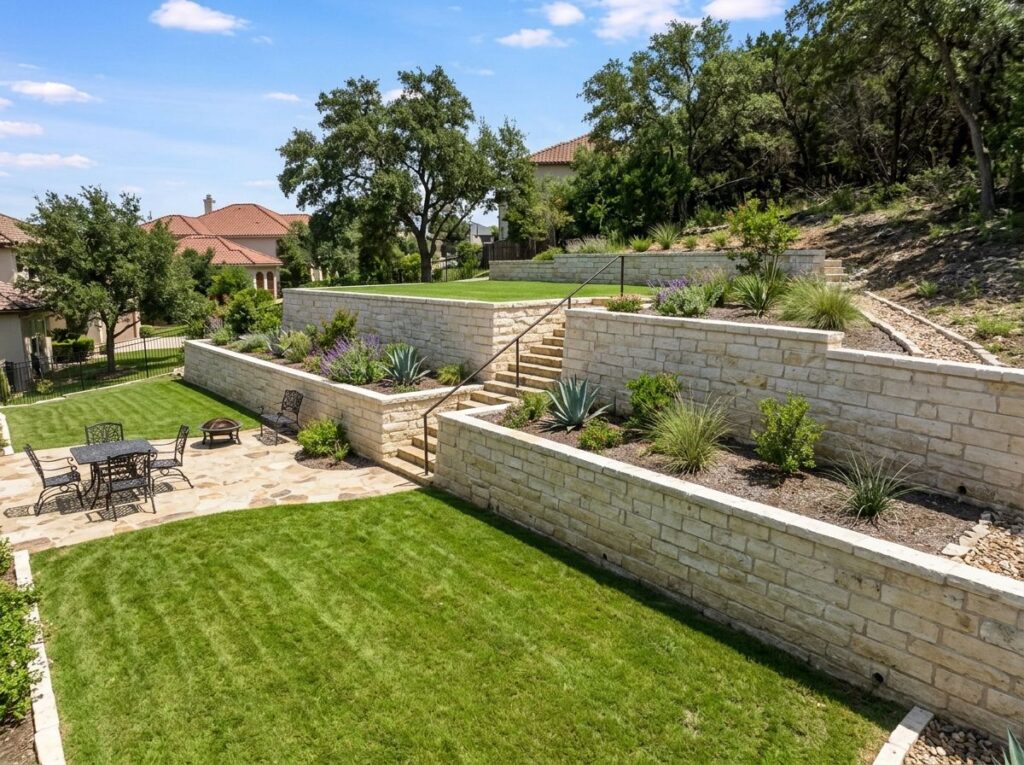
- Stabilizes steep slopes and helps prevent erosion and washouts.
- Creates usable flat areas for patios, play spaces, or level lawn in a hilly yard.
- Can protect nearby structures, driveways, and walkways from soil movement.
- Allows you to combine grading, drainage, and Landscape Bed Installation into one coordinated project.
CONS
- A quality retaining wall with proper drainage is a significant investment compared with simple grading alone.
- Once built, walls are not easy to move or modify if you change your layout later.
- Poorly designed or underbuilt walls can fail and cost more to correct than doing it right the first time.
Need versus want matters when you look at budget
Here goes your text ... Select any part of your text to access the formatting toolbar.
How “Needing” a Wall Affects Budget Planning
Because retaining walls are one of the more significant outdoor investments, we separate situations where a wall is structurally necessary from those where it is mainly a design preference. That way, you can decide whether to prioritize wall work now or start with grading and drainage improvements. Before scheduling work, review our retaining wall expectations so the project expectations are clear.
- Retaining walls are typically quoted per square foot of wall face once height, length, and access are known.
- In many San Antonio yards, a combination of yard grading, drainage work, and a shorter wall can be more cost-effective than one very tall wall.
- Your written proposal should separate structural wall work from optional finishes like caps, lighting, and landscape beds where possible.
- Because soils, slopes, and nearby structures differ, the Retaining Wall Cost Guide for San Antonio is best used as a general context, not a firm quote.
Clarify the decision before you commit to masonry
Retaining Wall Need-to-Have FAQs
These answers focus on real triggers we see for retaining wall projects across San Antonio and the Hill Country.
See All Frequently Asked QuestionsWe typically start by planning drainage.
Controlling where water goes makes it easier to design a wall that will last. In many projects, Drainage Installation and Retaining Wall Installation are designed together so they support each other instead of working against the natural flow of water.
Related: Signs Your Yard Has Drainage Problems, Retaining Wall Installation, Retaining Wall Drainage: Why It Matters
If the area is already fairly level and sits on stable soil, you may be able to build a patio with minor grading.
If the patio will cut into a slope or sit near a drop-off, a retaining wall or low seat wall may be needed to hold back soil and create safe, long-lasting edges.
Related: Signs Your Yard Has Drainage Problems, Retaining Wall Installation, Retaining Wall Expectations Policy
On gentle slopes, deep-rooted plants and groundcovers can help stabilize soil and reduce erosion.
On steeper slopes or where soil is already moving significantly, plantings alone are usually not enough. In those cases, a combination of grading, drainage work, and a retaining wall may be the safer long-term solution.
Related: Signs Your Yard Has Drainage Problems, Retaining Wall Installation, Retaining Wall Drainage: Why It Matters
There is no single height that applies to every yard, but once grade changes reach a couple of feet and you see erosion, instability, or difficulty using the area, it is worth evaluating a wall.
Local codes may also require engineering or specific construction methods over certain heights.
Related: Signs Your Yard Has Drainage Problems, Contact Us, Do I Need a Permit for a Retaining Wall?
If you are already seeing movement, cracking, or significant erosion, a wall may need to be a higher priority. If your main goal is layout and aesthetics, you may be able to phase work by starting with grading, drainage, and Sod Installation, then adding walls and hardscapes as budget allows. A site visit and clear plan will help you decide what should come first.
Related: How to Prepare Your Yard for Sod Installation, Signs Your Yard Has Drainage Problems, Sod Installation
Short garden walls that hold back only a few inches of soil behave very differently from walls managing several feet of grade change.
The taller the wall and the more load it carries, the more attention we give to base, drainage, and sometimes engineering requirements.
Related: Signs Your Yard Has Drainage Problems, Retaining Wall Installation, Retaining Wall Expectations Policy
Plan the right fix, not just the most expensive one
Want a Straight Answer on Whether You Need a Retaining Wall?
We can walk your property, look at slopes, drainage, and structures, and give you a clear recommendation—whether that’s Retaining Wall Installation, grading and drainage improvements, or a mix of both.