
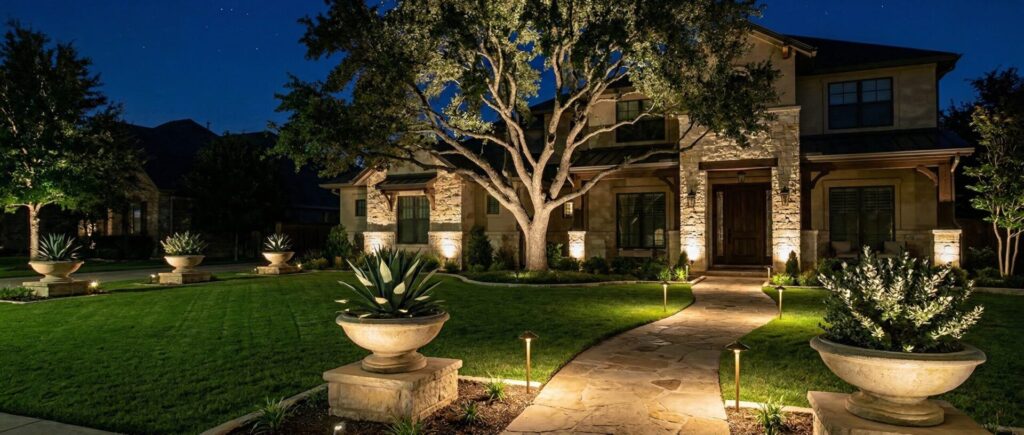
Size your system around how you use your yard at night
How Many Landscape Lights Do I Really Need for My San Antonio Home?
There is no magic number that fits every yard. The right fixture count depends on what you want to see at night—entries, walks, trees, beds, patios, and pool areas—not just your square footage. This guide walks you through practical ranges so your Landscape Lighting Installation fits your home instead of guessing in the dark.
Request Your Free EstimateStart with zones, then refine the numbers
Typical Fixture Counts for San Antonio Landscape Lighting
For most San Antonio homes, a professionally designed low-voltage LED system uses somewhere between 6 and 24+ fixtures, depending on how many areas you want to light. A compact front entry may only need 6–8 lights, while a full front yard plus a backyard entertaining space can easily call for 16–24 or more.Instead of chasing a fixed number, it helps to think in zones. First decide which areas must be lit for safety—steps, walks, and entries—then layer in accent lighting for trees, architectural features, and outdoor living spaces. Each new zone adds a handful of fixtures to the design.This guide will give you realistic ranges by scenario so you can quickly see whether you are planning for a small, standard, or whole-property system before you request a detailed design from San Antonio Landscaping Services.
- Small front-entry systems often use 6–8 fixtures
- Typical front-yard layouts commonly land between 10–16 fixtures
- Front + backyard entertaining zones can require 16–24+ fixtures
- Corner lots and whole-property designs may need 24–36+ fixtures to avoid dark gaps
Decide what should disappear and what should stand out
A Practical Framework for Determining Fixture Count
The goal is not to hit a fixture quota. The goal is to make your home feel safe, welcoming, and intentional after dark. Here is how we work through fixture counts with homeowners in San Antonio and the surrounding Hill Country.
1. Identify your must-light safety zones first
We always start with safety. These are the areas you should almost never leave dark:
- Front walkways and steps.
- Driveway transitions and grade changes.
- Front door, side door, and main garage entries.
On most homes, this baseline translates to 4–8 fixtures: a run of path lights at comfortable spacing, plus a few accents on the porch or garage. Once these are covered, you can decide how far to extend your Landscape Lighting Installation into the yard.
2. Decide which features deserve accent light
After the safety zones, we look at focal points. Common examples in San Antonio neighborhoods include:
- Signature oak or cedar elms in the front yard.
- Stone or stucco columns, arches, or entry features.
- Chopped stone borders, Landscape Bed Installation, or specimen plants.
Each focal point usually takes one to three fixtures, depending on size. A large live oak may need two or three uplights from different angles, while a stone column might need only a single, carefully aimed fixture. Adding two or three focal areas can quickly move a system from 8–10 lights into the 12–16+ range.
For lighting component planning, compare modern bollard light with the areas you want to illuminate.
For lighting component planning, compare adjustable spot light with the areas you want to illuminate.
3. Add backyard and side-yard function zones
If you spend evenings on the patio, around the pool, or grilling, it makes sense to allocate fixtures there as well. Typical backyard zones might include:
- Patio or deck perimeter lighting for comfortable conversation light.
- Soft lighting around a pool, spa, or fire feature.
- Key steps or paths leading to side yards, gates, or Drainage Installation swales that double as walking routes.
Backyard zones often add another 6–10 fixtures to the total, depending on how deep into the yard you go. We frequently see San Antonio homes land in the 16–24 fixture range once both curb appeal and outdoor living spaces are included.
For a related next step, read LED vs Halogen Landscape Lighting.
For a related next step, read Is Landscape Lighting Worth It?.
For a related next step, read Low Voltage Landscape Lighting Explained.
4. Match beam spreads and brightness to avoid over-lighting
Fixture count is only half the equation. Beam angles, lumen output, and mounting height affect how much ground each fixture covers. In many cases, a single properly chosen fixture can replace two undersized ones:
- Narrow beams to highlight tall trees or architectural details without lighting the whole neighborhood.
- Wider beams to gently wash walls or plant masses.
- Lower-output fixtures near seating areas to keep light comfortable on the eyes.
By tuning these variables, we keep counts reasonable while still achieving an even, intentional look. This is where a design visit pays off more than any “X lights per square foot” rule you might find online.
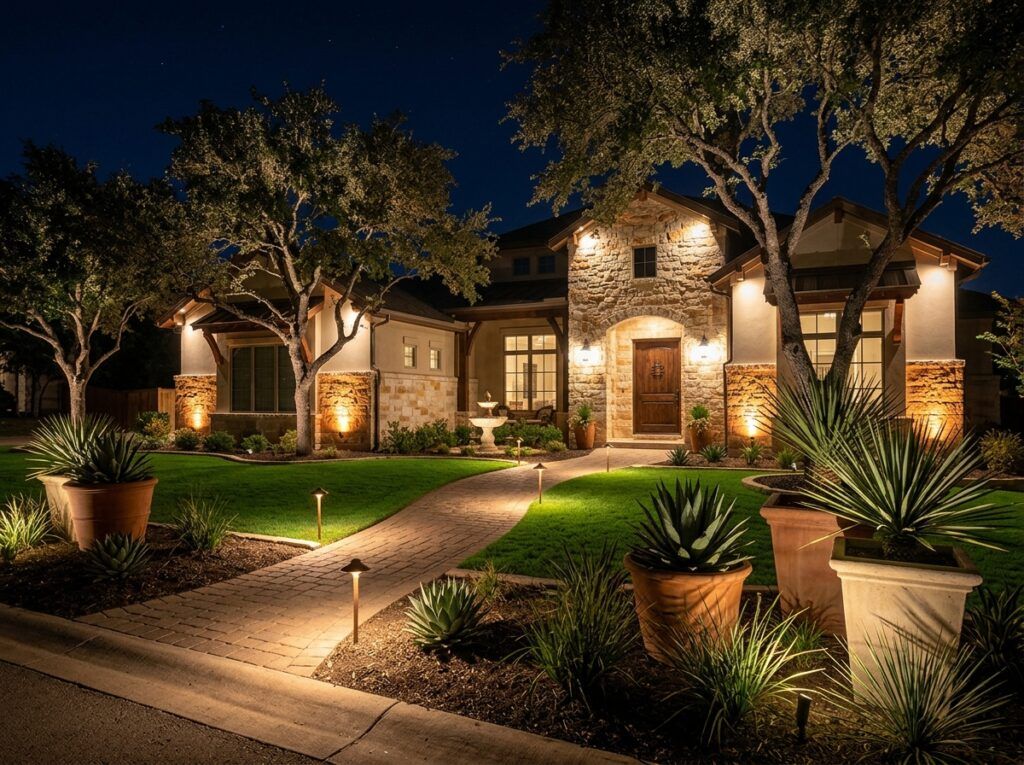
Here goes your text ... Select any part of your text to access the formatting toolbar.
Fixture Count Ranges by Typical San Antonio Home Scenario
| Home Scenario | Typical Fixture Count | Main Zones Lit | Design Notes |
|---|---|---|---|
| Compact front entry | 6–8 fixtures | Front walk, porch/garage, one small tree or feature | Focus on safe footing and a welcoming entry; keep beam spreads tight. |
| Standard front yard | 10–16 fixtures | Walkways, façade, 1–2 feature trees, key beds | Balance path lights with a few uplights on architecture and trees. |
| Front yard + single backyard zone | 16–24 fixtures | Front curb appeal plus a patio, deck, or pool seating area | Use zones so you can dim or switch entertainment areas separately. |
| Corner lot or full-property layout | 24–36+ fixtures | Front, sides, and key backyard spaces | Often uses multiple transformers and careful wire routing to keep voltage even. |
These are planning ranges for typical San Antonio lots, not a quote. Your design will reflect your home’s architecture, trees, and how you use each space at night.
Planning by zone keeps lighting intentional
Pros and Cons of Using Fixture Ranges to Plan Your System
PROS
- You can plan lighting in logical zones instead of guessing a random fixture count.
- Starting with a right-sized design reduces the risk of dark gaps or overlit “stadium” hot spots.
- Knowing typical ranges makes it easier to match your wish list to a realistic budget.
- Designing by zone now makes it simple to add fixtures later without redoing the whole system.
CONS
- Rule-of-thumb fixture ranges are still estimates; a site visit is required for a precise design.
- Trying to light every surface can lead to glare and higher fixture counts than you truly need.
- Focusing only on fixture quantity can distract from fixture quality, aiming, and beam control.
Fixture count and budget should be designed together
Here goes your text ... Select any part of your text to access the formatting toolbar.
How Fixture Count Connects to Landscape Lighting Cost
Knowing a realistic fixture range for your home helps you understand whether you are planning for a smaller, standard, or more comprehensive system. From there, we can align fixture quality and layout complexity with a budget that makes sense for your property. Before scheduling work, review our project guidelines so the project expectations are clear.
- Fixture count is one input into pricing, but fixture quality, wiring paths, and controls matter just as much.
- Two designs with the same number of lights can be priced very differently depending on fixture type and layout complexity.
- We often design in phases: start with a core zone, then pre-plan wiring and transformer capacity for future fixtures.
- Your written Landscape Lighting Installation proposal will show counts, locations, and options so you see what each zone costs.
Dial in fixture counts before installation day
Fixture Count FAQs for Landscape Lighting in San Antonio
Common questions homeowners ask when trying to decide how many lights they really need.
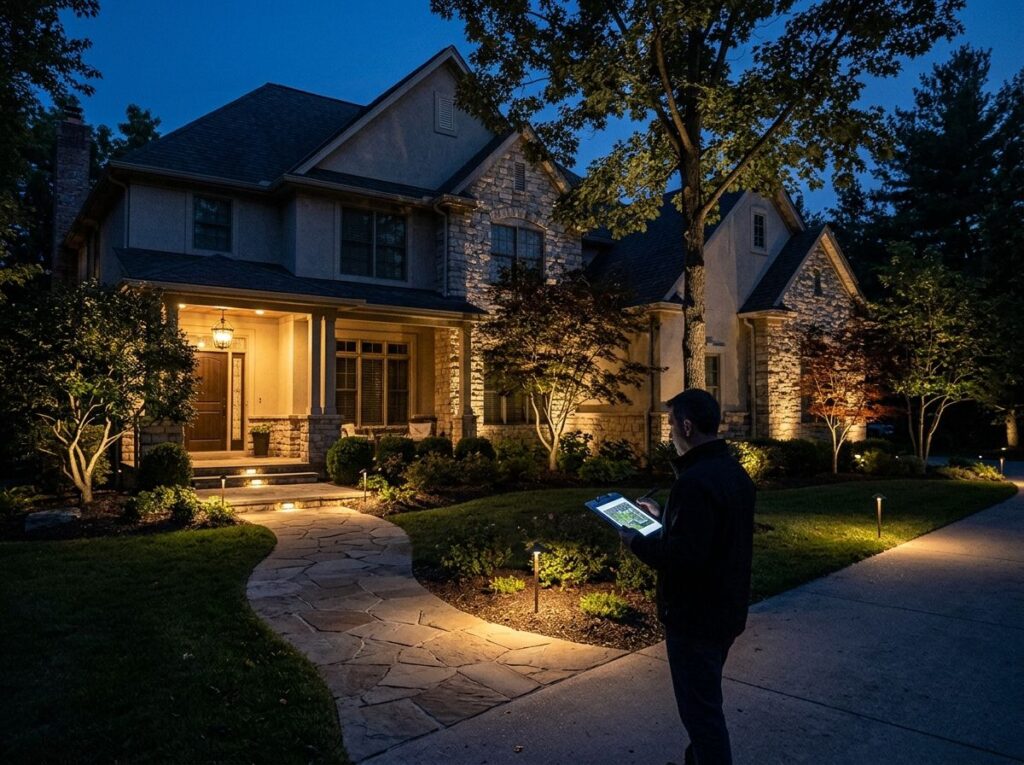
See All Frequently Asked QuestionsWe walk the property with you—often near sunset—identify safety zones and focal points, talk through how you use the yard, and then lay out fixture locations on a plan.
That design drives the exact fixture count and is reflected in your written proposal.
Related: Home, How to Design a Clean, Modern Front Yard, Faqs/#You Finalize The Exact Number Of Lights For My Home
Not always. What matters most is how many areas you want illuminated. Some homeowners focus only on the front and a single backyard zone, even on larger lots. Others want full-property coverage. Fixture counts follow those decisions.
Related: Retaining Wall Drainage: Why It Matters, When Do You Need a Retaining Wall?, Do I Need a Permit for a Retaining Wall?
Absolutely. During your Landscape Lighting Installation design, we can size the transformer, plan wire runs, and leave capacity in certain zones so future fixtures can be added without starting over.
Related: Landscape Lighting Installation, How to Design a Clean, Modern Front Yard, Is Landscape Lighting Worth It?
Yes. Over-lighting can create glare, wash out the house, and bother neighbors. Our goal is to layer light so the eye is drawn to key features, not to light every surface at full brightness.
Related: Landscape Lighting Installation, Is Landscape Lighting Worth It?, Landscape Lighting Cost Guide
Under-lighting often leaves pathways, steps, or corners in shadow and makes your home look patchy at night.
You might save a little up front, but it usually leads to an expansion project later. Starting with the right count is more efficient.
Related: Home, Project Guidelines Policy, When Is the Best Time to Install Sod?
Boxed kits are built around a generic layout, not your specific home.
They may not include the right mix of beam angles or brightness levels, and you can end up with dark gaps or hot spots. A custom design sizes fixture count to your actual architecture and yard.
Related: Home, How to Design a Clean, Modern Front Yard, Does Artificial Turf Get Hot in Texas?
Turn rough ranges into a tailored lighting plan
Want a Precise Fixture Count for Your Property?
We’ll review your goals, walk the property, and design a low-voltage LED system sized to your home and how you actually use your outdoor spaces at night. No guessing, no one-size-fits-all kit.