
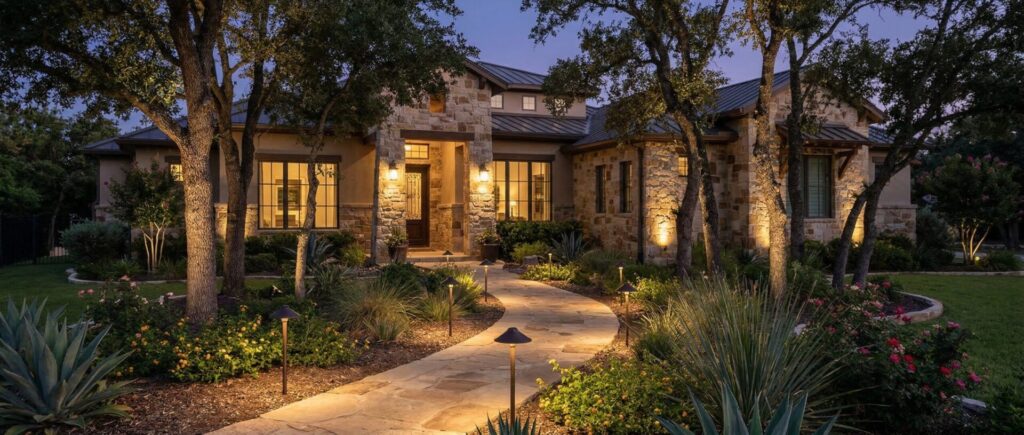
Understand the system behind safe, efficient outdoor lighting
Low Voltage Landscape Lighting Explained for San Antonio Homes
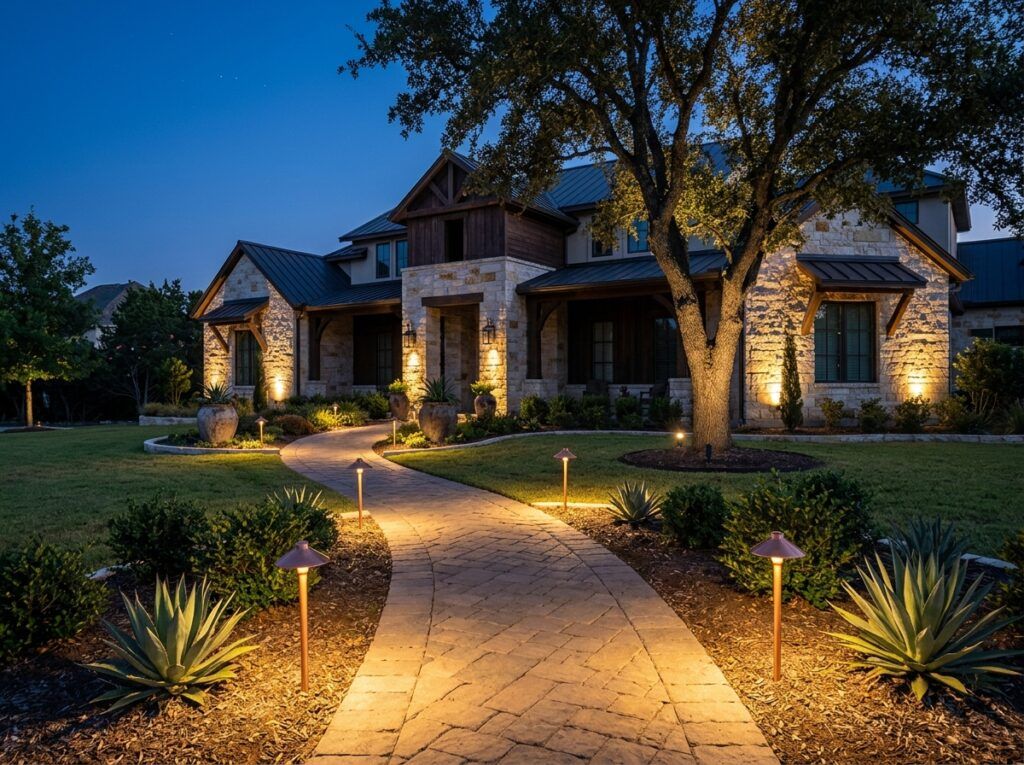
Most residential landscape lighting in San Antonio uses low voltage (12-volt) systems—not full 120-volt house power. A transformer steps down the voltage, then feeds fixtures through buried cable to create safe, efficient lighting around walks, beds, and patios. This guide breaks down how those systems work so you can make clear decisions about your next Landscape Lighting Installation.
Request Your Free EstimateSafe, efficient, and flexible for residential yards
What Is Low Voltage Landscape Lighting—and Why Use It?
Low voltage landscape lighting uses a transformer to reduce household power (120 volts) down to roughly 12 volts before it reaches your outdoor fixtures. That lower voltage makes the system safer around planting beds, walkways, and family spaces, while still providing plenty of light with modern LED fixtures.Because low voltage systems run cooler and use less power, they are a natural fit for San Antonio homes that want year-round path, accent, and patio lighting without a large jump in the electric bill.For most residential projects, low voltage is the standard approach. Line-voltage lighting is reserved for special situations, while solar kits are best viewed as temporary or low-output options.
- Uses a transformer to step power down from 120V to about 12V
- Safer around kids, pets, and planting beds than line-voltage systems
- Pairs well with long-lasting LED fixtures for low operating cost
- Flexible to design in zones and expand as your landscape evolves
Look at the whole system, not just the fixtures
How a Low Voltage Lighting System Actually Works
Understanding the basic components of a low voltage system makes it easier to read proposals, compare options, and decide what belongs in your Landscape Lighting Installation plan.
1. The main components: transformer, cable, and fixtures
A low voltage system is built around a few core parts that all have to work together:
- Transformer: Steps household power down to roughly 12 volts and often includes built-in timers or photocells.
- Low voltage cable: Carries power from the transformer out to each fixture along designated runs.
- Fixtures: Path lights, spotlights, wall lights, tree lights, and step lights that convert power into usable, controlled light.
When a Landscape Lighting Installation is designed correctly, the transformer has enough capacity, the cable runs are laid out thoughtfully, and fixtures are positioned to avoid glare while covering key areas like steps, walks, trees, and architectural elements.
2. Voltage, wattage, and why design matters
Even though low voltage systems are safer, they still require real planning. Two main concepts matter: voltage and wattage.
- Wattage: Each LED fixture draws a small amount of power. Add up all fixtures on a transformer to determine the total load.
- Voltage drop: The farther power travels along a cable, the more the voltage can drop, especially with long runs and higher loads.
A good design makes sure the total wattage stays within the transformer’s capacity and that cable runs are laid out to keep voltage drop within acceptable limits. That way, fixtures at the end of the line are just as reliable as those near the transformer.
For lighting component planning, compare smart timer hub with the areas you want to illuminate.
For lighting component planning, compare photocell timer plug with the areas you want to illuminate.
For lighting component planning, compare flexible conduit kit with the areas you want to illuminate.
3. Layout, zoning, and how you actually use the space
Low voltage systems are flexible, which is one of their biggest advantages. Rather than tying everything to one switch, you can group fixtures into zones based on how you use your yard:
- One zone for front walkways and the entry, so the front of the home is always safe and welcoming.
- Another for patios, outdoor kitchens, or seating areas, so you can control evening gatherings independently.
- Separate zones for tree uplighting, Retaining Wall Installation accents, or key Landscape Bed Installation features.
Well-thought-out zones make it easy to adjust your lighting with timers, photocells, or smart controls without over-lighting areas you are not using.
For a related next step, read How Long Does Outdoor Lighting Last?.
For a related next step, read Landscape Lighting Cost Guide.
For a related next step, read How Many Landscape Lights Do I Need?.
4. Safety, code, and when to call a professional
Even though low voltage systems are safer than line-voltage wiring, they still need to be installed correctly:
- Cable should be buried at appropriate depths and routed away from obvious digging and aeration zones.
- Connections must be weather-resistant and rated for direct burial to prevent corrosion and intermittent failures.
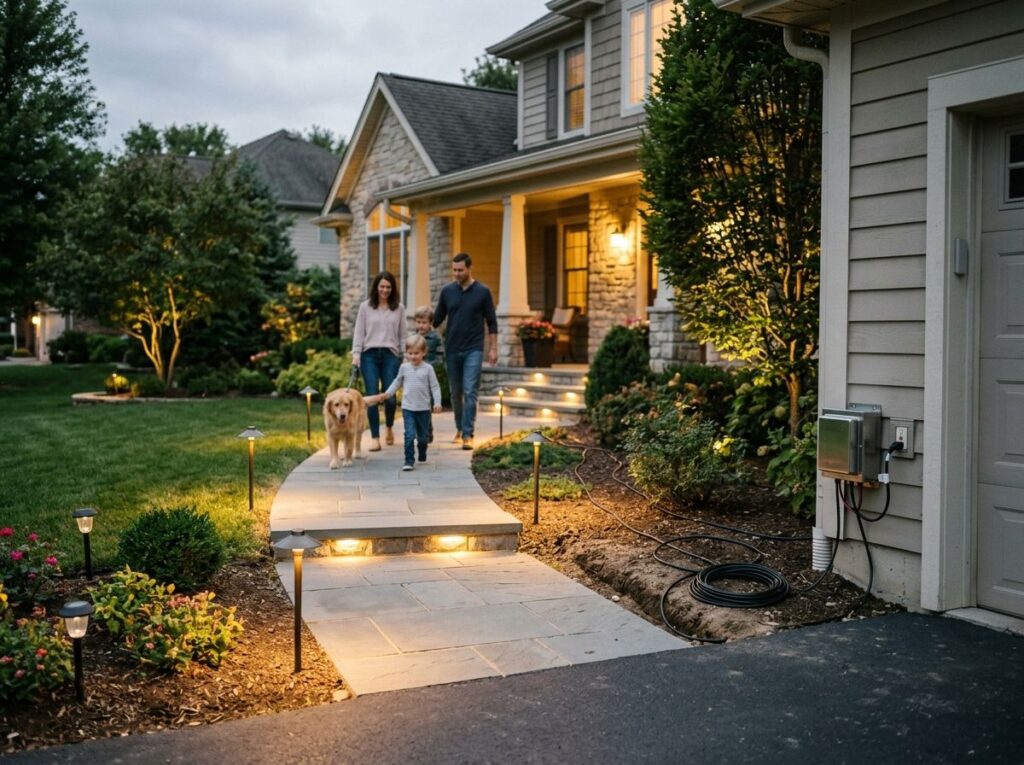
- The transformer should be mounted securely, often near an exterior GFCI outlet, with consideration for drainage and access.
Homeowners can sometimes add a small number of fixtures to an existing system, but new systems—especially those tying in with Drainage Installation, new beds, or hardscape—are best designed and installed by a contractor who works with low voltage lighting every day.
Here goes your text ... Select any part of your text to access the formatting toolbar.
Low Voltage vs Line Voltage vs Solar Landscape Lighting
| Option | Typical Use | Safety | Installation & Maintenance | Control & Flexibility | Operating Cost |
|---|---|---|---|---|---|
| Low Voltage (12V) LED System | Most San Antonio residential projects | Very safe around kids, pets, and planting beds | Requires transformer, proper cable sizing, and professional layout; long-term, low maintenance | Zones, timers, dimmers, and smart controls are easy to integrate | Low; LED fixtures use very little power |
| Line Voltage (120V) Fixtures | Special situations, commercial or tall pole lighting | Higher hazard if damaged; must be handled as full electrical work | Requires conduit, junction boxes, and electrical permitting in many cases | Good control options but harder to modify after installation | Higher; lamp wattages are usually greater than low-voltage LED |
| Solar Path/Spot Lights | Temporary or low-budget path lighting | Low; no wiring, but fixtures can be knocked over or misplaced | Simple to place, but performance varies with sun exposure and battery age | Limited control; most are dusk-to-dawn only | Very low, but may need frequent replacement |
For most homes, a low voltage LED system provides the best balance of safety, control, and long-term cost.
Know the strengths and limits before you commit
Pros and Cons of Low Voltage Landscape Lighting
PROS
- Safer around children, pets, and planting beds than line-voltage systems.
- Works extremely well with modern LED fixtures that use less power and last longer.
- Flexible to design in zones so you can control front, back, and accent lighting separately.
- Easier to expand in phases as you add new Landscape Bed Installation, trees, or hardscape.
- Typically far more reliable and consistent than solar kits, especially in shaded or partial-sun areas.
CONS
- Still requires proper design, transformer sizing, and cable layout to avoid dim or uneven lights.
- Needs an appropriate location for the transformer with access to a GFCI outlet.
- Long wire runs and large loads must be planned carefully to avoid voltage drop.
- Quality fixtures and professional installation cost more upfront than basic solar lights.
- DIY connections that are not weatherproof can cause future troubleshooting and repair issues.
Focus on design, quality, and long-term ownership
Here goes your text ... Select any part of your text to access the formatting toolbar.
Cost Factors for Low Voltage Lighting Systems
Low voltage systems are priced based on the quality of fixtures, the number of lights, the complexity of cable routing, and the type of controls you choose—not just the wattage on the box. A clear design makes it easier to see where the value is and how to phase the project if needed. Before scheduling work, review our project guidelines so the project expectations are clear.
- Total cost depends on the number and type of fixtures, the length of wire runs, and how difficult it is to route cable around existing features.
- Transformer size is selected based on the total wattage of the system with room for future expansion where possible.
- Upgrading to higher-end fixtures or integrated LEDs raises upfront cost but can improve lifespan and reduce maintenance.
- Bundling low voltage Landscape Lighting Installation with Landscape Bed Installation, Retaining Wall Installation, or Drainage Installation can reduce trenching and site-disruption costs.
- Your written proposal should list fixture counts, transformer size, controls, and zones so you can see where each dollar is going.
Clear answers about low voltage systems
Low Voltage Landscape Lighting FAQs
These questions focus on how low voltage systems work and what to expect in a residential setting.
See All Frequently Asked QuestionsCables are typically buried a few inches below the surface, deep enough to protect them from routine foot traffic and lawn care. In areas with heavy digging or aeration, cable routes are planned carefully or extra protection is used.
Related: Sod Care Policy, Faqs/#How Deep Do Low Voltage Cables Need To Be Buried
Often, yes. If the transformer and cable runs were sized with extra capacity, additional fixtures can be added in future phases. This is one reason planning with expansion in mind is important from the beginning.
Related: How Many Landscape Lights Do I Need?, Faqs/#Add More Lights To A Low Voltage System Later
Transformers are usually mounted near an exterior GFCI outlet on a wall or structure with reasonable protection from overspray and standing water. During a design visit, the installer will suggest locations that balance access, safety, and appearance.
Related: Project Guidelines Policy, Signs Your Yard Has Drainage Problems, Why Standing Water Is Dangerous for Lawns & Foundations
For consistent, long-term results, low voltage lighting is usually the better choice.
Solar lights are simple to place, but their brightness and run time depend on sun exposure and battery condition. Low voltage systems provide reliable, even light night after night.
Related: Faqs/#Is Low Voltage Lighting Better Than Using Solar Lights Aroun
Yes. Many transformers and control systems can be tied into smart timers, Wi‑Fi controllers, or compatible outdoor plugs so you can manage schedules and zones from a phone or central panel.
Related: How Long Does Outdoor Lighting Last?, Faqs/#Can Low Voltage Lighting Be Integrated With Smart Timers Or
Yes. Brightness depends on fixture selection and layout, not just voltage. Properly designed low voltage systems using quality LED fixtures provide more than enough light for walks, steps, and patios while avoiding harsh glare.
Related: Faqs/#Is Low Voltage Lighting Bright Enough For My Walkways And St
Turn the concept into a plan for your yard
See How Low Voltage Lighting Would Work on Your Property
We will walk the property with you, review how you use your outdoor spaces, and design a low voltage system that fits your layout and budget—whether you want a focused front entry, a full-property design, or a phased approach.