
Make the right call
Mulch vs Rock: Which Is Better for Your Landscape Beds in San Antonio?
Mulch and rock both work in South Texas—but they solve different problems. Use this decision framework to choose based on heat, weeds, maintenance style, and how often you plan to change plants.
Request Your Free EstimateQuick decision
Should you use mulch or rock in San Antonio beds?
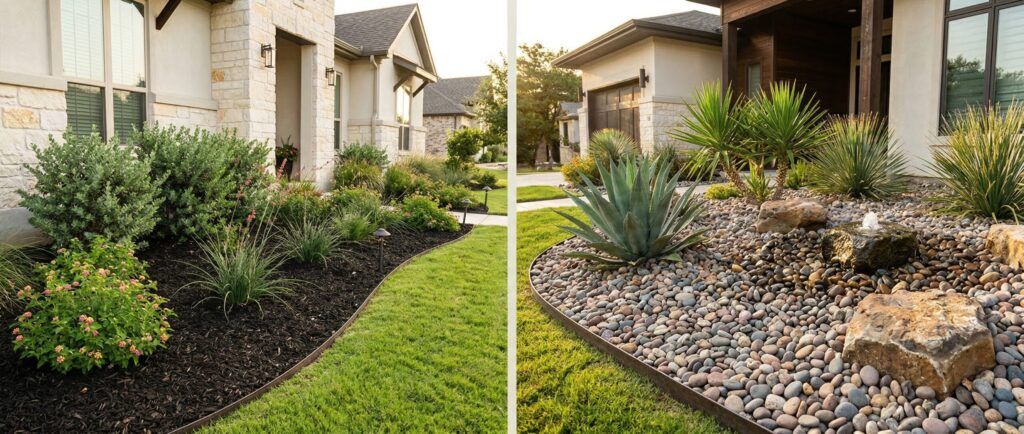
Choose mulch when you want healthier soil, cooler root zones, and flexibility to change plants over time. Mulch is the best all-around choice for planting-heavy beds and shaded areas.Choose decorative rock when you want a clean, low-refresh look, strong weed resistance (when installed with the right base and fabric), and you’re building a more permanent bed layout. Rock is often a better fit for modern front yards, sunny exposures, and xeriscape-style designs.The wrong choice usually isn’t the material—it’s installing it without proper prep, borders, and depth.
- Mulch = cooler beds + better soil + easier to change plants
- Rock = cleaner look + stronger weed resistance + less refreshing
- Mulch needs top-off every 12–24 months
- Rock needs solid borders or it migrates over time
- Both need proper prep; fabric matters more under rock than under mulch
- Slopes and drainage change the best choice
Contractor-level framework
A Decision Framework That Works in South Texas
In San Antonio, the best ground cover choice depends on sun exposure, bed purpose, and how you want to maintain the space. Here’s how we evaluate it on real projects.
Start with the bed’s job: planting bed or finish bed?
Planting beds are built to support plants: better soil, better moisture retention, easier replanting. Mulch usually wins here.
Finish beds are built for clean visual structure: fewer plant changes, strong borders, tidy look. Rock often wins here.
- If you expect to add/replace plants often, mulch keeps changes simple.
- If you want “set it and keep it clean,” rock performs well when installed correctly.
Heat and moisture: what happens in full San Antonio sun
Rock can hold heat, especially near reflective surfaces (driveways, walls, pool decks). That heat can stress smaller shrubs and new plantings. Mulch generally runs cooler and slows evaporation, which helps plants establish.
If your beds are south- or west-facing, mulch is usually the safer default around most plants—unless your planting palette is truly heat-hardy and the bed is designed for rock.
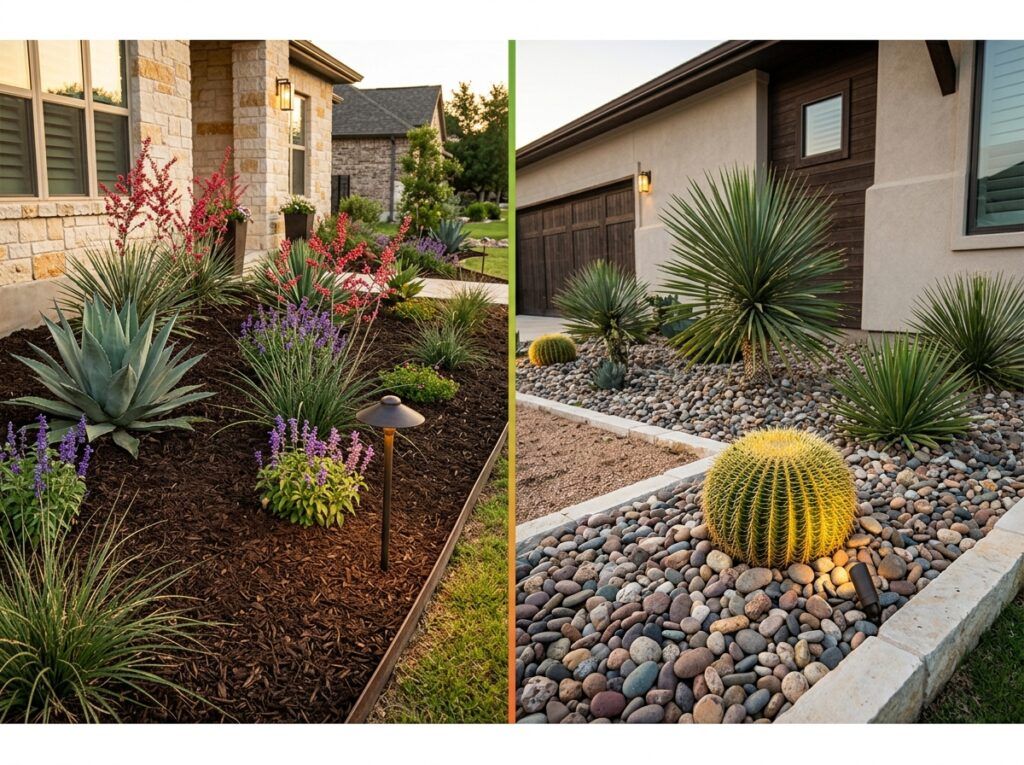
For ground-cover material planning, compare dark native mulch with the site conditions discussed above.
For ground-cover material planning, compare Texas blend river rock with the site conditions discussed above.
For ground-cover material planning, compare decomposed granite with the site conditions discussed above.
Weeds: the real reason people choose rock
Rock can be excellent for weed resistance, but only when the system is built correctly:
- Proper bed prep (remove existing growth, shape and compact where needed)
- Correct fabric selection and overlap
- Enough rock depth to block sunlight
- Solid edging to keep rock in place
Without those steps, weeds still happen—and now they’re harder to remove because they grow through rock and fabric cuts.
For a related next step, read Best Edging Options for Landscape Beds.
For a related next step, read How Often Should You Refresh Mulch?.
For a related next step, read Low-Maintenance Landscape Bed Ideas.
Maintenance reality: “refresh” vs “clean”
Mulch maintenance is a refresh cycle: clean up leaves, edge the bed, then top-off mulch every 1–2 years depending on exposure and depth.
Rock maintenance is a cleanliness cycle: blow debris off regularly, spot-treat weeds as needed, and occasionally re-level areas where rock migrates. If you let organics build up on top of rock, weeds will root in that layer.
Here goes your text ... Select any part of your text to access the formatting toolbar.
Mulch vs Rock Comparison (San Antonio Conditions)
| Decision Factor | Mulch | Decorative Rock | Best Fit For |
|---|---|---|---|
| Upfront installed cost | Lower (lighter material, faster install) | Higher (heavy material + edging detail) | Mulch: budget-focused refresh Rock: long-term, low-refresh look |
| Heat performance | Stays cooler than rock and protects soil | Can hold heat and raise root-zone temps | Mulch around plants that struggle in heat |
| Weed control | Good with proper depth; needs refresh | Very good with fabric + correct depth | Rock for low-maintenance weed control (when installed correctly) |
| Soil health | Improves soil as it breaks down | Neutral; can limit organic matter unless beds are amended | Mulch in planting-heavy beds |
| Maintenance style | Top-off every 12–24 months | Blow off debris; occasional re-level / weed spot treatment | Mulch for “refresh” cycles Rock for “keep it clean” cycles |
| Storm impact | Can wash out on slopes without edging | More stable, but can migrate without border | Rock for moderate slopes with borders Mulch for flat beds |
| Planting changes later | Easier to dig and rework | Harder: move rock, cut fabric, rebuild | Mulch when you expect to change plants |
| Pests | Can attract termites if piled against wood; can harbor some insects | Less organic attraction; can still hide pests if debris builds up | Either works with clean detailing and correct clearances |
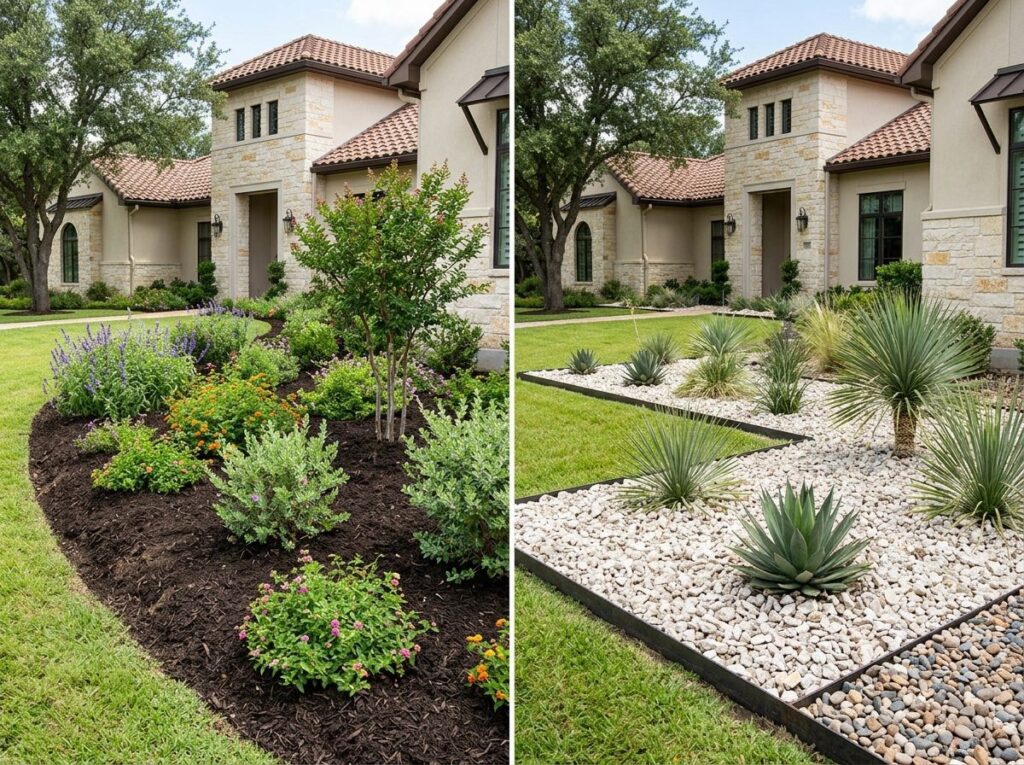
| Best look | Natural, soft, “garden” feel | Clean, modern, xeriscape / architectural feel | Mulch for lush planting beds Rock for modern low-water landscapes |
Balanced view
Pros and Cons (No Fluff)
PROS
- Mulch: improves soil over time
- Mulch: cooler root zone in heat
- Mulch: easier to replant and redesign
- Rock: long-lasting visual finish
- Rock: strong weed resistance when installed correctly
- Rock: works well for modern, low-water bed designs
CONS
- Mulch: needs top-offs and refreshes
- Mulch: can wash out on slopes without edging
- Mulch: should not touch wood trim or fence posts
- Rock: higher upfront cost (material + labor)
- Rock: can hold heat in full sun
- Rock: planting changes later are slower and messier
Real pricing logic
Here goes your text ... Select any part of your text to access the formatting toolbar.
How Mulch vs Rock Changes Cost
Mulch is usually the lower-cost installed ground cover because it’s lighter and faster to place. Decorative rock costs more because it’s heavy, it often needs stronger edging, and the system depends on proper fabric and depth.Rather than one “bed price,” contractors quote the components: bed prep, fabric (when appropriate), ground cover by yard, and edging by linear foot. Before scheduling work, review our landscape bed expectations so the project expectations are clear.
- Mulch installed: typically $45–$75 per cubic yard
- Decorative rock installed: typically $90–$180 per cubic yard
- Rock usually needs stronger edging to prevent migration (priced per linear foot)
- Slopes, tight access, and heavy removal increase labor regardless of ground cover
- If drainage is poor, ground cover won’t fix it—Drainage Installation may be needed
Common questions
Mulch vs Rock FAQs
Clear answers based on real bed installs in San Antonio.
See All Frequently Asked Questions- limit soil improvement over time (mulch is meant to feed the soil)
- become exposed as mulch shifts or thins
- make future planting or bed refreshes harder
- reduce mixing between rock and soil
- help the bed look cleaner longer
- make maintenance and future refreshes simpler
Sometimes, but not always. It depends on what material you’re installing (mulch vs. rock) and what problem you’re trying to solve.
Under mulch: fabric can create long-term issues because mulch breaks down over time. That organic material turns into soil on top of the fabric, and weeds can still grow in that new layer. Fabric can also:
Under rock: fabric is more commonly helpful because it can:
Our approach: we recommend fabric based on your material plan, bed design, and site conditions. The goal is a bed that looks good now and stays manageable long term — not a “one-size-fits-all” install.
Helpful next step: Learn more about mulch vs. rock landscape beds and native mulch.
Yes—and it’s often the best approach. Use mulch in planting-heavy foundation beds and rock in accent areas, side yards, and modern front-yard zones where you want a clean, long-term finish.
Related: Landscape Bed Installation Cost Guide, How to Design a Clean, Modern Front Yard, How Often Should You Refresh Mulch?
It depends on the look and how you want it to perform. Crushed limestone locks together more than round river rock, while river rock has a softer look but can migrate more without strong borders.
Related: Landscape Bed Installation Cost Guide, Faqs/#What Rock Is Best For San Antonio Beds
Mulch doesn’t create termites, but it can provide cover and moisture if piled against wood. Keep mulch a few inches away from wood trim, fence posts, and weep screeds, and maintain proper clearances.
Related: Landscape Bed Installation Cost Guide, How Often Should You Refresh Mulch?, Faqs/#Does Mulch Attract Termites
It can in full sun, especially near reflective surfaces. Heat-hardy plant selections and bed design matter. Mulch is generally safer for new plantings and moisture retention.
Related: Landscape Bed Installation Cost Guide, Landscape Bed Installation, Landscape Bed Expectations Policy
Not always. Rock is low-refresh, but it still needs regular debris clearing. If leaves and soil build up on top, weeds will grow in that layer. Mulch needs top-offs, but weeding can be easier.
Related: Landscape Bed Installation Cost Guide, How Often Should You Refresh Mulch?, Low-Maintenance Landscape Bed Ideas
Get it built right
Want a Bed Design That Looks Clean and Stays Clean?
We’ll evaluate sun exposure, slope, and maintenance goals, then recommend the right ground cover system (mulch or rock) with the proper prep and edging for long-term performance.