
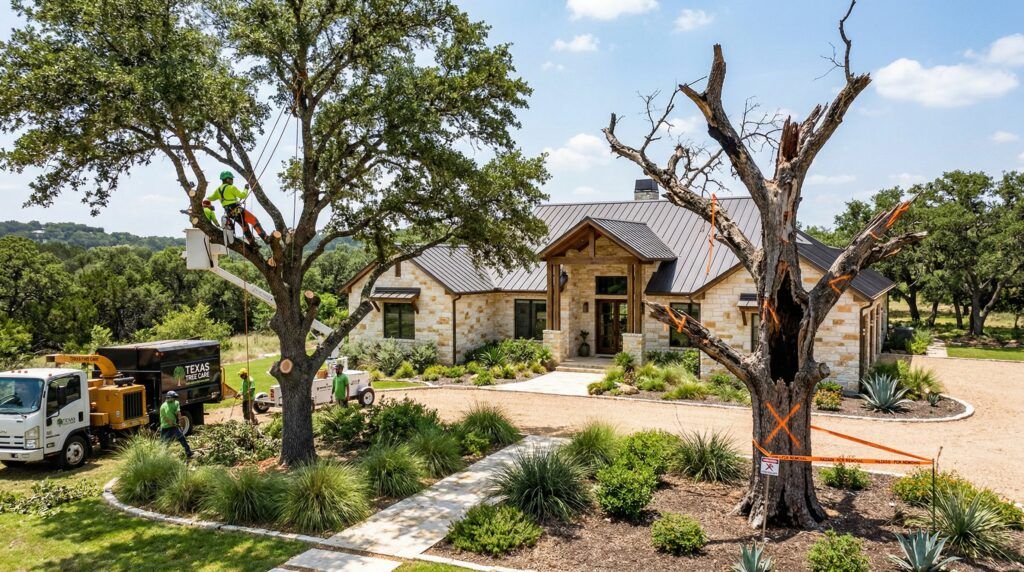
Know when to shape it, when to remove it, and when to stop waiting.
When Does a Tree Need Trimming vs Removal?
Some trees need a careful trim to improve structure, clearance, and curb appeal. Others are the wrong fit for the space and are better removed entirely. This guide helps you understand the difference so you can make the right decision before a tree becomes a bigger problem.
Request Your Free EstimateStart with function, safety, and fit.
Should You Trim the Tree or Remove It?
A tree usually needs trimming when the main issue is shape, clearance, balance, light structure correction, or branch contact with roofs, fences, or walkways. In those cases, selective trimming can improve the way the tree looks and performs without taking it out.Removal becomes the better option when the tree is the wrong fit for the space, repeatedly causes problems, is overcrowding the area, blocks important sight lines, or is declining badly enough that trimming will not solve the real issue.For small-to-medium trees, the right choice often comes down to this question: can the problem be corrected with careful pruning, or is the tree itself still going to be a problem even after trimming?
Trim when the goal is shape, clearance, balance, or controlled size reduction.
Remove when the tree is the wrong fit, repeatedly causes problems, or no longer makes sense in the space.
A good trim improves structure without aggressive topping or careless hacking.
Removal is often the better long-term move when trimming would only delay the same issue.
A practical homeowner framework.
How to Tell Whether a Tree Should Be Trimmed or Removed
Homeowners often wait too long because they think every tree problem can be fixed with trimming. In reality, some trees improve dramatically with good pruning, while others keep causing the same headaches year after year. The goal is not to cut just because you can. The goal is to decide whether the tree still belongs there.
When trimming is usually the right move
Trimming makes sense when the tree is basically worth keeping, but it needs correction or control. That often includes trees that are brushing the roof, pushing into fences, hanging too low over walkways, or growing unevenly.
- Clearance issues: Limbs are too close to the house, driveway, walkway, or fence.
- Balance and shape: The canopy looks lopsided or overgrown on one side.
- Light structure work: Small deadwood, crossing branches, or minor crowding can be corrected.
- Curb appeal: The tree still fits the yard, but it needs to look cleaner and more intentional.
For small-to-medium trees, a controlled trim can restore clearance and appearance without the cost or disruption of removal.
When removal is usually the better long-term choice
Removal is often the better call when the tree is not just overgrown—it is the wrong fit for the space or keeps creating problems that trimming will not really solve.
- Wrong location: The tree was planted too close to the home, driveway, patio, or other permanent features.
- Repeated conflict: You trim it back, but it quickly returns to the same roof, fence, or view-line issue.
- Overcrowding: The tree blocks other plants, throws too much shade, or makes the bed or yard layout stop working.
- Poor condition: Large dead sections, obvious decline, or severe structural problems may make removal more sensible than repeated pruning.
In these cases, removal can open space for a better landscape layout and stop the cycle of constant correction.
For plant planning, compare live oak with the site conditions discussed above.
For plant planning, compare juniper shrubs with the site conditions discussed above.
Questions to ask before deciding
If you are unsure, ask these four questions:
- Does the tree still fit the space?
- Will trimming actually solve the issue, or only delay it?
- Is the tree improving the yard, or constantly working against it?
- If removed, would the space be better used for another planting or landscape feature?
That last question matters more than people think. Many removals are not about a tree being “bad.” They are about the tree no longer matching the way the yard needs to function.
For a related next step, read What’s Included in Tree and Shrub Trimming?.
For a related next step, read Tree Trimming Cost Guide.
For a related next step, read Best Time to Trim Trees and Shrubs.
How this works with your service scope
For this service, the practical decision usually applies to shrubs, hedges, and small-to-medium trees. Trees are trimmed up to about 20–25 feet, and selective removals are available for small-to-medium trees up to about 20 feet. Stump grinding can also be added after removal or booked as a standalone service.
That means the question is not “Can we do everything?” The better question is “Within the tree sizes we handle, is careful trimming enough, or is removal the smarter move?”
Clear scope boundaries help protect both the property and the final result. Work near power lines is not part of this service, and site restoration after removal is quoted separately when needed.
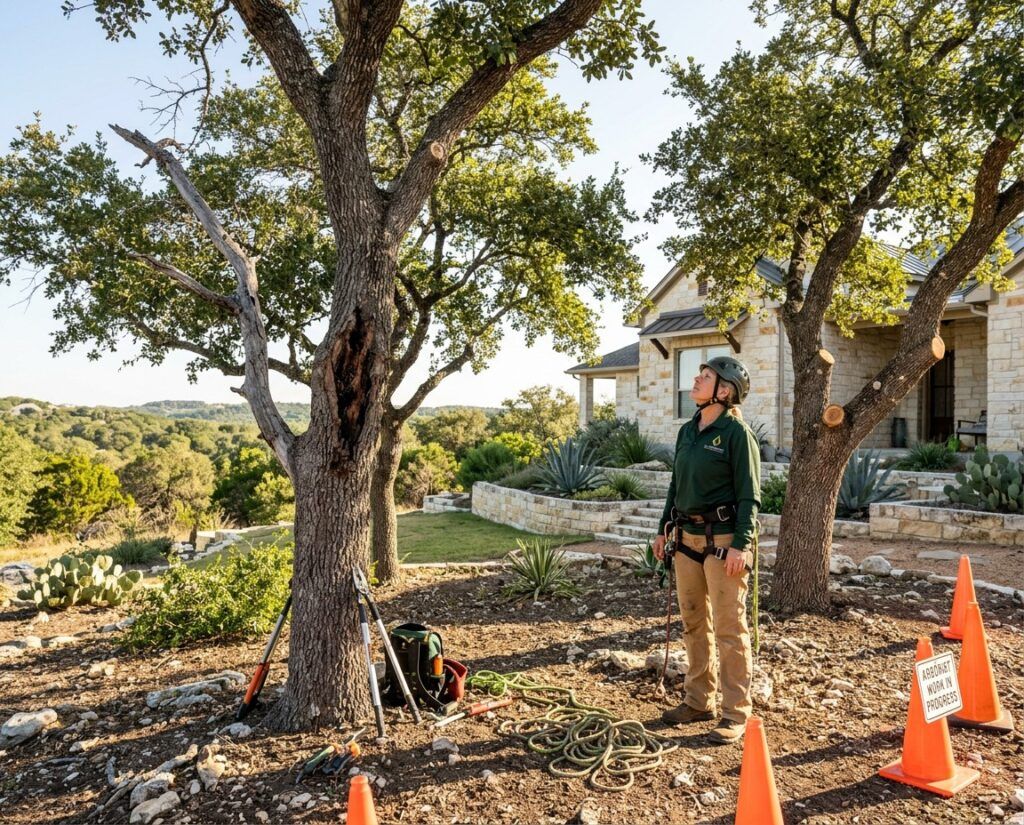
Here goes your text ... Select any part of your text to access the formatting toolbar.
Tree Trimming vs Tree Removal: Which Situation Fits Each?
| Situation | Usually Better for Trimming | Usually Better for Removal |
|---|---|---|
| Branches touching roof or fence | Yes, if selective clearance solves it | Only if it keeps happening because the tree is badly placed |
| Tree looks uneven or overgrown | Yes, if structure and balance can be improved | No, unless it is the wrong tree for the space |
| Tree is too close to the house | Sometimes, for short-term management | Often yes, if long-term conflict is unavoidable |
| Tree blocks views, walkways, or use of the space | Yes, if light pruning fixes it | Yes, if trimming would need to be repeated constantly |
| Tree is declining badly or has major dead sections | Rarely | Often yes, depending on overall condition |
| Tree is simply the wrong fit for the landscape plan | Usually not the best long-term answer | Often yes |
Each option solves a different problem.
Pros and Cons of Trimming vs Removal
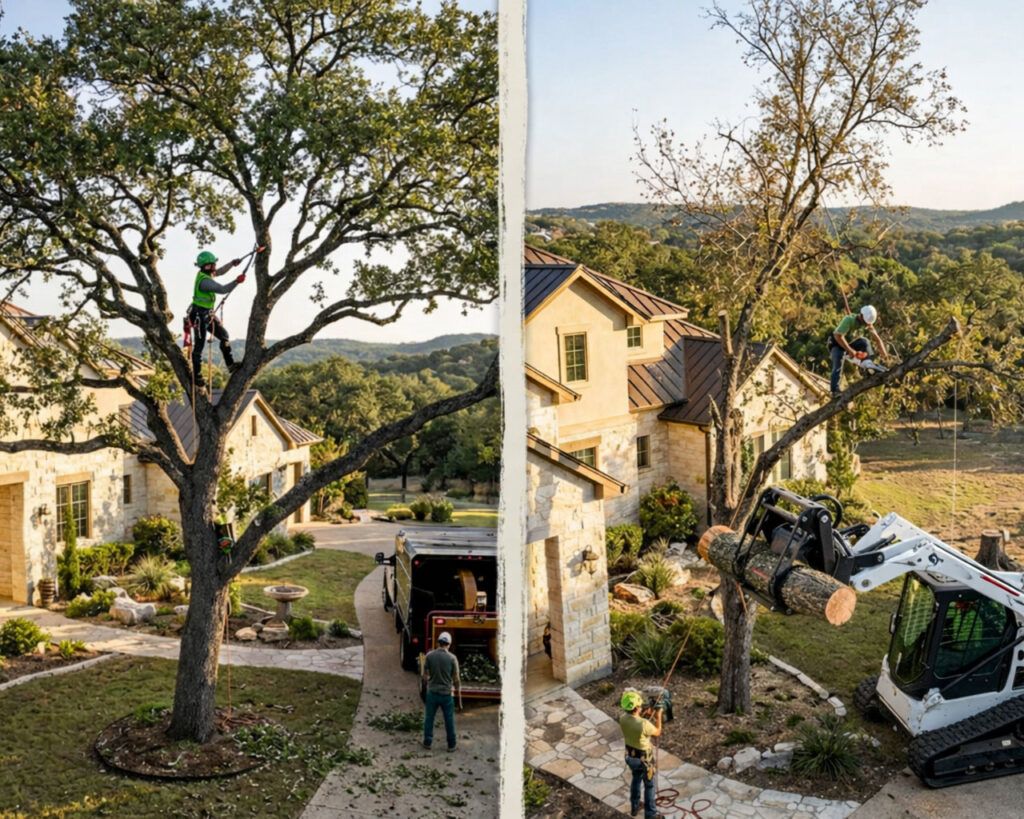
PROS
Trimming preserves a tree that still adds value to the yard.
Selective pruning can improve clearance, shape, and curb appeal without major disruption.
Removal can permanently solve repeated space, view, and clearance conflicts.
Removal can open room for a better planting layout or landscape redesign.CONS
Trimming will not fix a tree that is fundamentally in the wrong location.
Removal changes the look and shade pattern of the yard immediately.
Repeated trimming can become inefficient if the same problem keeps returning.
Removal and stump grinding are usually a larger project than a simple trim.
Broad ranges are more useful than fake certainty.
Here goes your text ... Select any part of your text to access the formatting toolbar.
How Trimming vs Removal Affects Cost
Tree trimming is usually priced lower than removal because the tree stays in place and the work focuses on selective cutting, shaping, clearance, and cleanup. Removal generally costs more because it includes taking the tree down safely, sectioning it, hauling away debris, and sometimes coordinating optional stump grinding.The exact price depends on height, canopy density, access, obstacles, debris volume, and how much cleanup detail is required. Pricing can change at any time, so the goal of this guide is not to lock in numbers. It is to help you understand why a “trim it” project and a “take it out” project are priced differently. Before scheduling work, review our project guidelines so the project expectations are clear.
Trimming cost is driven by size, density, access, and cleanup detail.
Removal cost is broader because it includes dismantling, hauling debris, and sometimes optional stump grinding.
Small-to-medium trees may fall into either category depending on fit and condition, not just height.
Written quotes confirm exact scope and current pricing.
Pricing can change at any time based on labor, disposal, equipment, and site conditions.
Common decision-making questions.
Tree Trimming vs Removal FAQs
These questions help clarify when a tree still makes sense to keep and when removal is the better long-term call.
See All Frequently Asked QuestionsLight touch-up work may be possible, but aggressive pruning in peak summer heat is usually avoided because it can add stress, increase sunscald risk, and slow recovery. July and August are generally not the preferred time for heavy corrective trimming.
That is a smart first step. Many homeowners just need a practical evaluation of whether the tree still belongs in the space. Once that decision is clear, the quote for trimming or removal becomes much easier to understand.
Not by default. Regrading, sod repair, replanting, or bed restoration are considered separate landscaping services unless they are specifically listed as follow-up work in the quote.
No. Standard removal includes taking the tree down, cutting and hauling away the debris, and leaving the yard rake-clean. Stump grinding is optional and is quoted separately unless it is specifically included in the written scope.
If you have already trimmed the same tree more than once for the same issue—roof contact, blocked views, fence friction, or overcrowding—there is a good chance trimming is only managing the symptom, not solving the problem.
No. A tree can be healthy and still be the wrong fit for the space. Removal is often chosen because the tree blocks light, crowds the landscape, interferes with structures, or no longer works with the layout of the yard.
Start with a clear recommendation.
Not Sure Whether the Tree Should Be Trimmed or Removed?
We can walk the property, look at the tree in context, and tell you whether a controlled trim makes sense or whether removal is the better long-term move. You will get a clear written scope so you know exactly what is being recommended.