
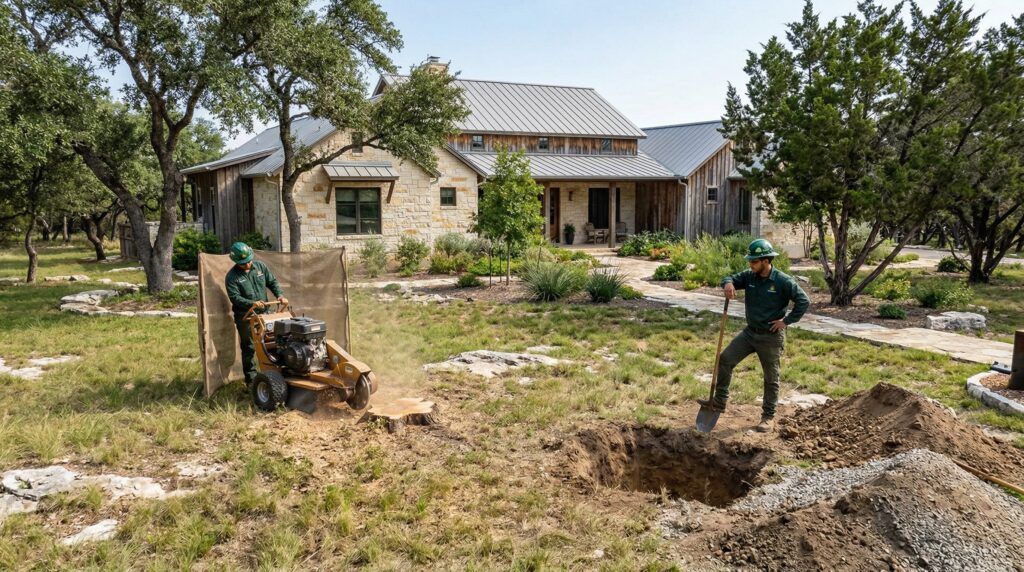
They sound similar, but they are not the same service.
Stump Grinding vs Stump Removal
Many homeowners say they want the stump “gone,” but that can mean two very different things. Stump grinding cuts the stump down below grade and leaves wood chips behind. Full stump removal is a more invasive process that removes more of the stump and root mass. This guide helps you understand the difference so you choose the right option for your yard and your budget.
Request Your Free EstimateMost residential jobs are solved by grinding.
What’s the Difference Between Stump Grinding and Stump Removal?
Stump grinding is a mechanical process that grinds the visible stump down below grade—typically several inches below the surface—while leaving most of the deeper root system in place. The result is usually a mound of wood chips and soil over the hole, which settles over time unless haul-off and backfill are added.Stump removal is more invasive. It usually involves pulling out more of the stump and root mass, disturbing more of the surrounding ground, and leaving a larger area that needs restoration afterward.For most residential landscape situations, stump grinding is the more practical option. It is usually faster, less disruptive, and more budget-friendly than full removal.
Stump grinding cuts the stump below grade but usually leaves deeper roots in place.
Stump removal is more invasive and disturbs a larger section of the yard.
Grinding usually leaves wood chips in the hole unless haul-off and backfill are added.
Most homeowners choose grinding because it is the cleaner and more practical option.
Choose based on the site, not just the word “remove.”
How to Decide Between Stump Grinding and Stump Removal
The best choice depends on what you want the area to become next. If the goal is to make the stump disappear visually and free up the surface area for future use, grinding is usually enough. If the goal is to eliminate more of the stump and root mass because of a major construction or excavation plan, removal may make more sense. For help turning the advice into a real project, review our tree and shrub trimming service page.
What stump grinding actually does
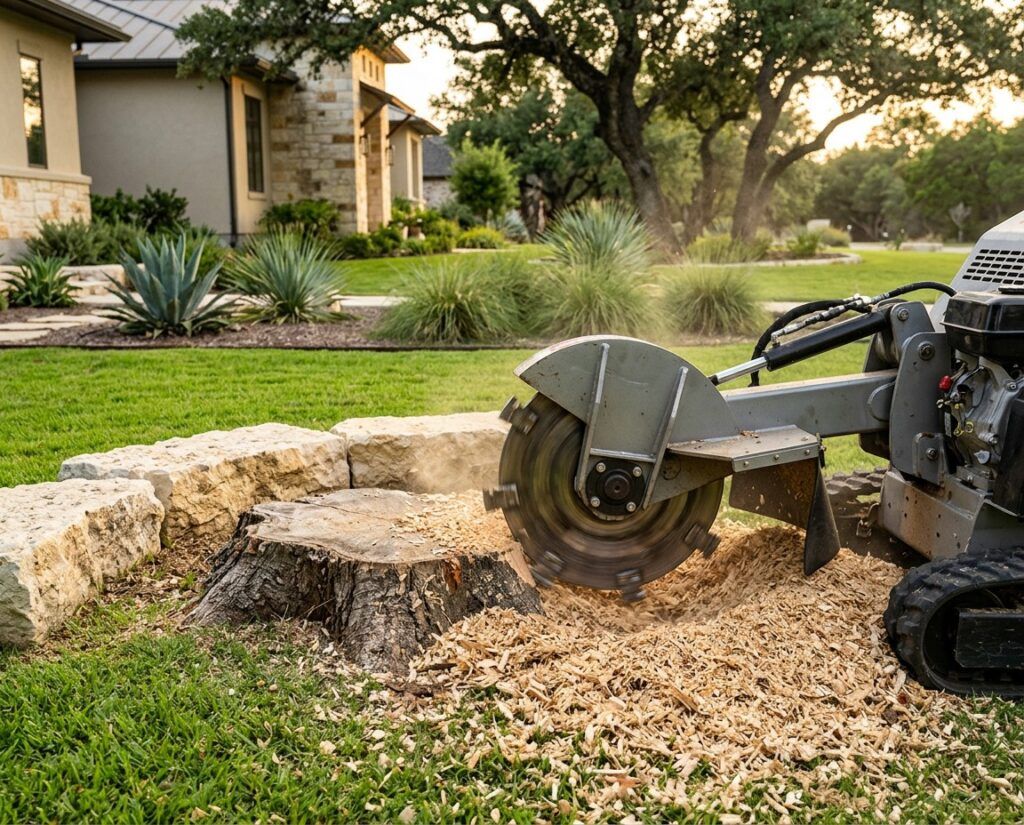
Stump grinding uses a grinding machine to chip away the stump down below grade. For a typical residential job, that usually means the visible stump is ground down enough that the area can later be topped with soil, sod, or other surface treatment.
By default, the grinding process creates a mix of wood chips and soil. In many cases, those grindings are raked into a neat mound over the hole because they will settle naturally over time. This is often called a “grind and mound” result, and it is the standard version of the service unless extra cleanup or restoration is added.
Grinding is a strong fit when the homeowner wants the stump out of sight and the site usable again without turning the yard into a major excavation area.
What full stump removal usually means
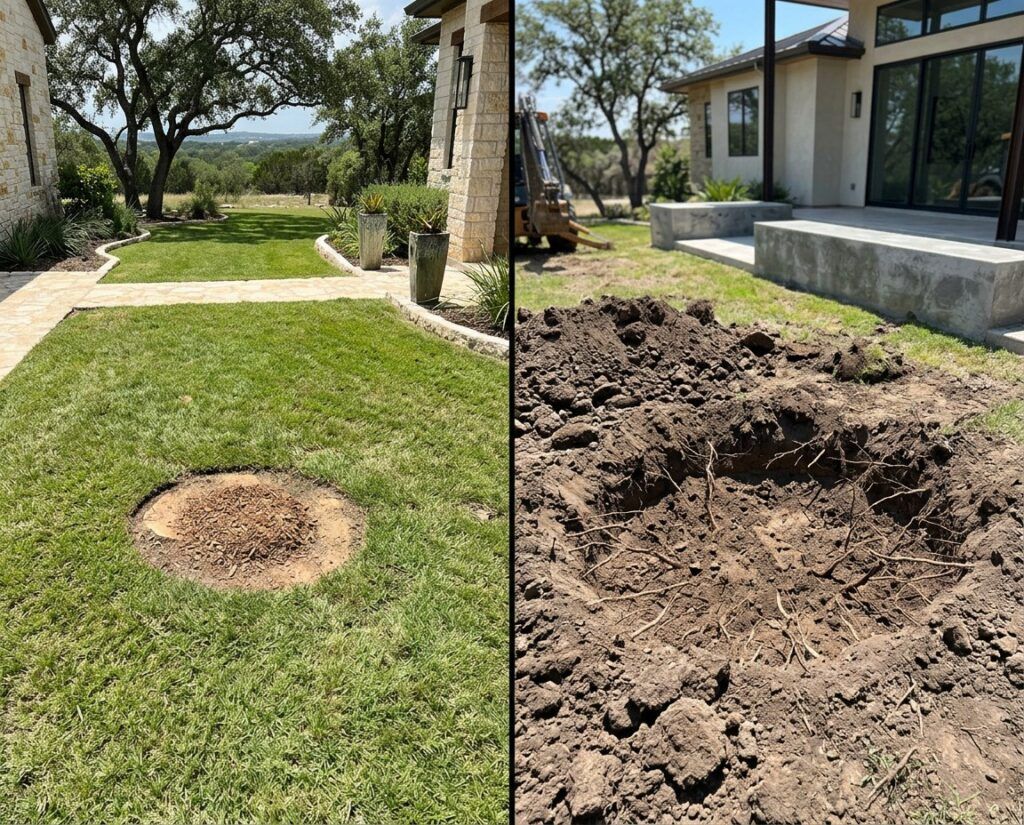
Full stump removal goes beyond grinding the visible stump. It usually means removing more of the stump body and attached root mass, which creates a larger hole and more soil disturbance.
- More invasive: more digging, more ground disturbance, and more restoration after the work.
- Larger cleanup: more material to manage and more site leveling afterward.
- Usually not necessary: many residential landscape goals can be solved with grinding alone.
Because of the added disruption, full stump removal is often reserved for situations where the surface and subsurface need to be cleared more aggressively for future work.
For ground-cover material planning, compare native mulch with the site conditions discussed above.
For ground-cover material planning, compare decomposed granite with the site conditions discussed above.
What happens after stump grinding
One of the biggest homeowner misunderstandings is what the site will look like after grinding. By default, stump grinding does not leave behind a fully restored lawn or planting bed. It leaves a ground stump area with a mound of wood chips and soil unless extra steps are added.
- Standard result: stump ground 6–12 inches below grade and grindings mounded neatly over the hole.
- Optional haul-off: chips and debris removed from the property.
- Optional soil fill and leveling: topsoil added and the area brought back closer to finish grade.
- Optional restoration: sod installation or bed preparation quoted separately.
That distinction matters because the “stump is gone” and “the site is restored” are not the same deliverable.
For a related next step, read What to Expect After Tree Removal and Stump Grinding.
For a related next step, read When Does a Tree Need Trimming vs Removal?.
For a related next step, read What’s Included in Tree and Shrub Trimming?.
When grinding is the smarter residential choice
For most homeowners, stump grinding is the right balance of speed, cost control, and minimal disruption. It handles the visible problem without turning the yard into a larger construction site.
Grinding is often the best choice when:
- You want the stump gone visually.
- You plan to add sod, topsoil, or bed material afterward.
- You want less disturbance to nearby lawn, beds, or hardscape.
- You do not need the full root mass excavated.
That is why stump grinding is commonly offered both as an add-on after tree removal and as a standalone service for old stumps left behind by previous work.
Here goes your text ... Select any part of your text to access the formatting toolbar.
Stump Grinding vs Stump Removal: Side-by-Side
| Factor | Stump Grinding | Stump Removal |
|---|---|---|
| Main goal | Remove the visible stump below grade | Remove more of the stump and root mass |
| Ground disturbance | Moderate and localized | Higher and more invasive |
| What stays behind | Most deeper roots remain, plus grindings unless hauled away | More of the stump/root mass is removed, leaving a larger excavation area |
| Typical residential fit | Very common and usually sufficient | Less common and more situational |
| Restoration needed after | Often optional but recommended if appearance matters | Usually more extensive |
| Budget impact | Usually lower | Usually higher |
The simpler choice is often the better one.
Pros and Cons of Stump Grinding vs Removal
PROS
Stump grinding is usually faster and less disruptive than full removal.
Grinding is often enough for sod repair, bed refresh, or general cleanup goals.
Grinding can be booked as a standalone service or added after tree removal.
Optional haul-off and restoration let homeowners control how finished the site becomes.CONS
Grinding does not remove the entire root system.
The site is not fully restored by default unless backfill or sod work is added.
Full stump removal is more disruptive and usually more expensive.
Homeowners who expect a finished lawn immediately after grinding may misunderstand the standard result.
Think in service level, not just stump size.
Here goes your text ... Select any part of your text to access the formatting toolbar.
How Stump Grinding and Stump Removal Affect Cost
Stump grinding is usually the more budget-friendly choice because the work is focused on cutting the stump below grade without turning the project into a larger excavation. Full stump removal generally costs more because it involves more disruption, more labor, more site disturbance, and more restoration afterward.Exact pricing depends on stump size, access, machine access, whether chips stay or are hauled away, and whether backfill, leveling, sod repair, or bed prep are added. Pricing can change at any time, so the purpose of this guide is to explain the cost logic rather than promise exact numbers. Before scheduling work, review our project guidelines so the project expectations are clear.
Grinding is usually priced lower than full removal because it is less invasive.
Haul-off, topsoil fill, leveling, sod repair, and bed prep are separate add-ons.
Tight access can change the price even when the stump is not especially large.
Standalone stump grinding may still have a minimum service threshold depending on mobilization.
Written quotes confirm exact scope and current pricing.
The questions that usually come up after the tree is already gone.
Stump Grinding vs Stump Removal FAQs
These answers help homeowners understand what the site will actually look like after stump work and why grinding is usually the preferred option.
See All Frequently Asked QuestionsYes. Stump grinding can be booked as a standalone service for old stumps already on the property, or it can be added after a fresh tree removal.
Full removal may make more sense when a project needs more of the stump and root mass out of the way for future excavation, construction, or a very specific site plan. For most residential yards, grinding is usually the more practical choice.
No. Many homeowners choose the standard grind-and-mound result and handle the settling naturally. Haul-off is useful when you want the area cleaned out more fully so it can be backfilled and restored sooner.
By default, the area usually has a mound of wood chips and soil over the hole where the stump was ground. That mound settles over time. If you want a cleaner finished look sooner, haul-off, topsoil fill, leveling, and restoration can be added.
Because the work is different. Shrubs are usually faster to shape and easier to clean up. Small tree trimming often involves more selective cuts, heavier material, and more caution around structures and clearances.
Not by default. The site usually needs decisions about chip haul-off, topsoil, leveling, and whether sod or bed prep will be added. If you want the area restored cleanly, that should be quoted as a separate follow-up scope.
Choose the stump service that fits the next step.
Need Stump Grinding or Want to Discuss the Best Option?
We can look at the stump, explain whether grinding is enough, and outline any optional cleanup or restoration work so you know exactly what the finished site will and will not include.