
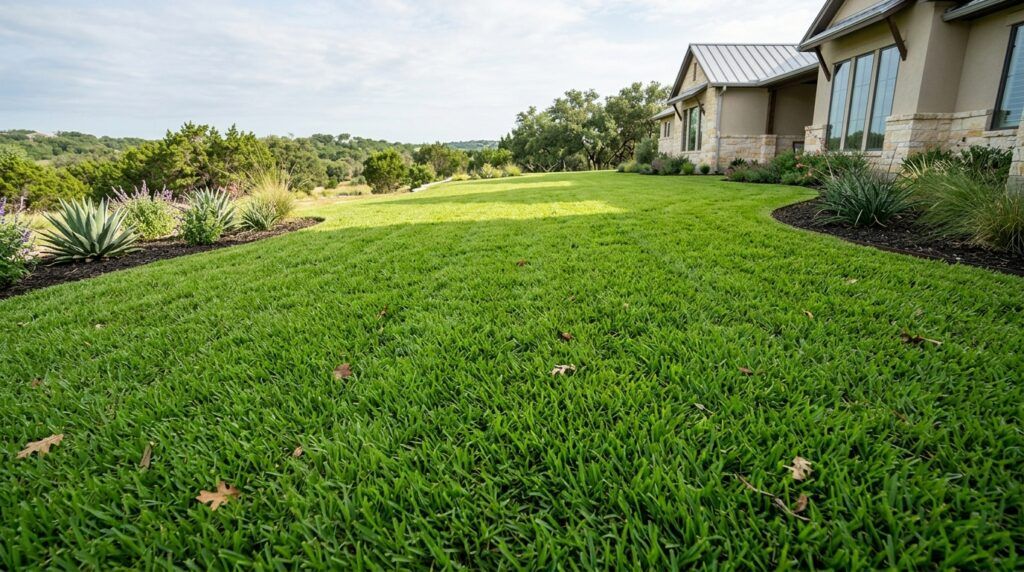
St. Augustine Grass Varieties We Install
- Floratam: Vigorous, coarse-bladed, and highly drought-tolerant. Best for full sun.
- Raleigh: Cold-hardy, medium texture, and adapts well to a range of soils.
- Palmetto: Fine texture, shade-tolerant, and maintains color in cooler weather.
- Delmar: Dense, shade-tolerant, and great for residential lawns.
Watering New St. Augustine Sod
During the first 2-3 weeks, water new St. Augustine sod daily, or more frequently in hot, dry weather, to keep it consistently moist but not overly wet. Early morning watering between 4 AM and 10 AM is best for reducing evaporation and helping prevent fungal issues. In peak heat, watering twice daily may be needed.
After establishment, water deeply and less frequently. Aim for about 1-1.5 inches of water per week, including rainfall, divided into two or three sessions. Encourage deep root growth by letting the soil dry slightly between waterings. During winter dormancy, reduce watering to once every two weeks if there is no rainfall.
Fertilizing Schedule
Wait 3-4 weeks after installation, or until the lawn has been mowed 2-3 times, before fertilizing. Fertilizing too early can damage young roots and slow establishment.
- Spring: Begin fertilizing about three weeks after spring green-up with a nitrogen-rich fertilizer, such as a 3-1-2 or similar ratio.
- Summer: Fertilize every 8-10 weeks with 1-1.5 pounds of nitrogen per 1,000 square feet per application.
- Fall: Apply a high-potassium, low-nitrogen fertilizer, such as 5-10-10 or 7-0-20, about six weeks before the first expected frost to promote winter hardiness.
- Winter: No fertilization is needed during dormancy.
Always water after fertilizing to help nutrients reach the roots. Avoid excessive fertilizer, which can cause disease and promote overgrowth. Soil testing is recommended every 1-2 years for optimal results.
Weed Control Timing
Weeds can appear in new St. Augustine lawns because pre-installation herbicide may reduce existing weeds, but seeds can remain in the soil. Wind, birds, and pets can introduce new weed seeds, and weeds are more common in thin or bare areas while the grass establishes.
Hand-pull weeds early, especially large or isolated ones. Mow regularly at the recommended height, water correctly, and fertilize properly to help St. Augustine thicken and outcompete weeds.
Wait until the lawn is well-established and has been mowed 3-4 times, about 60-90 days, before applying any herbicide. Avoid pre-emergent herbicides in the first growing season because they can inhibit root growth.
Use only products labeled safe for St. Augustine grass. The care instructions list Atrazine for broadleaf and grassy weeds on established lawns, Celsius WG for many broadleaf weeds, Image Southern Lawn Weed Killer formulated for St. Augustine with no Dicamba, Sulfentrazone for post-emergent control of many weeds, and Spectracide Weed Stop for Lawns in the St. Augustine formula. Avoid products containing Dicamba unless specifically labeled for use on St. Augustine. Never use non-selective herbicides, such as glyphosate or Roundup, on your lawn.
Mowing Height and First Cut
Wait 21-28 days after installation, or until the sod is well-rooted, before the first mow. Test by gently tugging the sod. For the first mow, set the mower to a higher setting of 3.5-4 inches and remove only the top portion of the grass.
Maintain St. Augustine at 2.5-4 inches during the growing season. In full sun, 2.5-3 inches is sufficient. In shade or during heat stress, raise the mowing height to 3.5-4 inches. Mow every 5-7 days during peak growth from May through September, and never remove more than one-third of the blade in a single mowing. Use sharp mower blades, avoid mowing wet grass, and mow only if needed in winter to even out the lawn.
Seasonal St. Augustine Care
- Spring, March to May: Begin mowing as the grass starts to green up. Fertilize about three weeks after green-up. Apply pre-emergent herbicide only if the lawn is established and not in its first season. Patch bare spots with sod as needed.
- Summer, June to August: Water deeply and consistently. Fertilize every 8-10 weeks. Mow every 5-7 days, adjusting height during heat or drought. Watch for chinch bugs and disease.
- Fall, September to November: Reduce watering as temperatures cool. Apply a high-potassium, low-nitrogen fertilizer six weeks before the first frost. Continue mowing as needed.
- Winter, December to February: Water minimally and irrigate only during extended dry spells. Do not fertilize. Mowing is usually not required unless the lawn becomes uneven.
Year-Round St. Augustine Tips
- Aeration: Aerate in late spring or early summer to relieve compaction.
- Dethatching: Remove thatch if the thatch layer exceeds 1/2 inch.
- Pest and disease monitoring: Inspect regularly for chinch bugs, grubs, and fungal issues.
- Edging: St. Augustine can creep into beds and walkways, so keep edges trimmed.
Recommended Weed Control Products for St. Augustine Lawns
- Atrazine: For broadleaf and grassy weeds; apply only to established lawns.
- Celsius WG: Safe for St. Augustine and effective against many broadleaf weeds.
- Image Southern Lawn Weed Killer: Formulated for St. Augustine with no Dicamba.
- Sulfentrazone: For post-emergent control of broadleaf and some grassy weeds.
- Spectracide Weed Stop for Lawns, St. Augustine formula: Always check the label.
Always follow label directions. Never use non-selective herbicides, such as Roundup or glyphosate, on your lawn.
Product Disclaimer
Product formulations and labels are subject to change. Always confirm compatibility with your grass type. San Antonio Landscaping Services is not responsible for any damage, injury, or loss resulting from the use or misuse of any product mentioned. Use at your own risk.
Questions? Contact San Antonio Landscaping Services for expert advice and assistance with your St. Augustine sod care.